
TL;DR
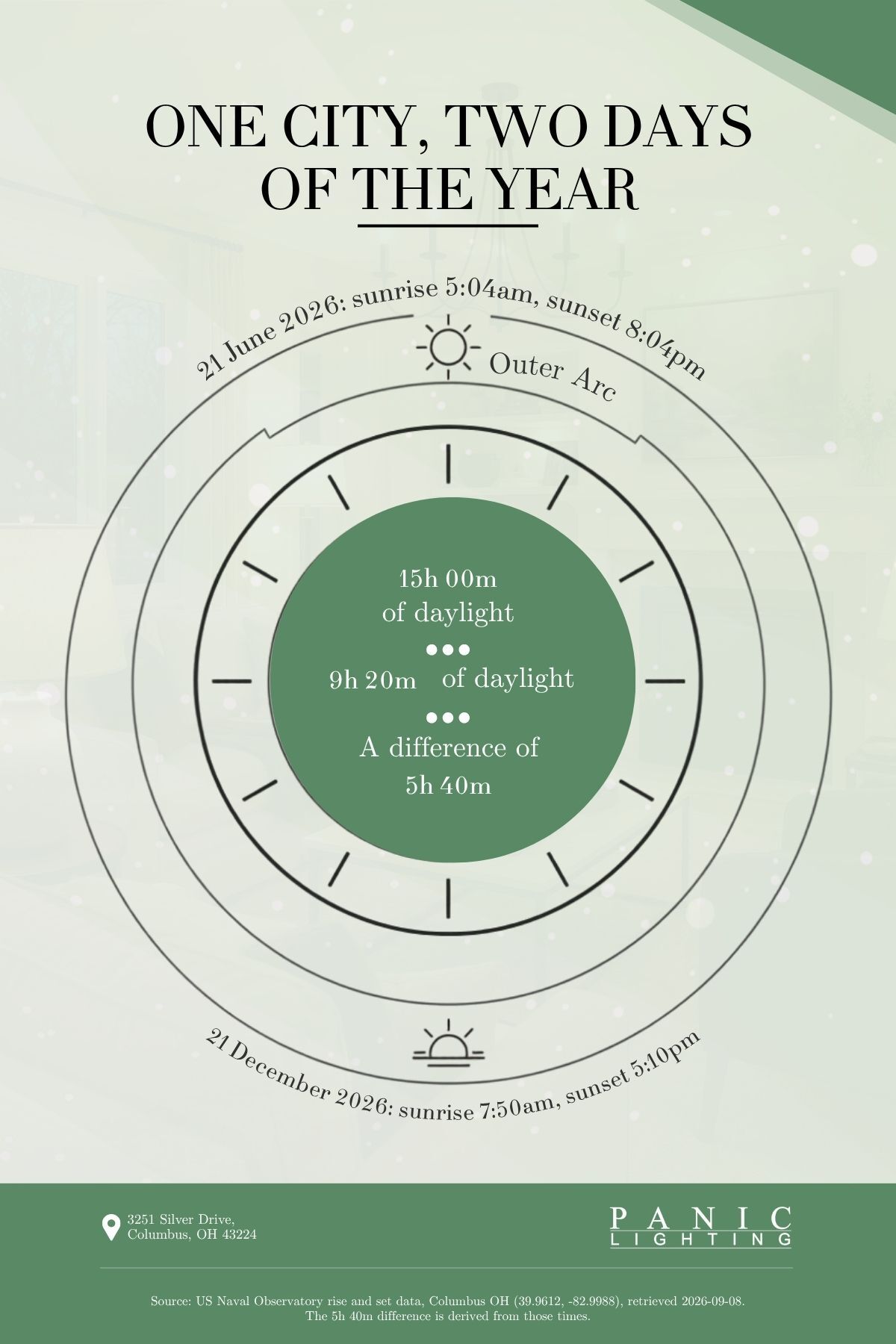
The US Naval Observatory publishes rise and set times for any coordinates, and for Columbus the swing is larger than it feels. On 21 June 2026 the sun rises at 5:04 am and sets at 8:04 pm, fifteen hours of daylight. On 21 December 2026 it rises at 7:50 am and sets at 5:10 pm, nine hours and twenty minutes. That is a loss of five hours and forty minutes of daylight between midsummer and midwinter.
Civil twilight ends at 5:41 pm in December, so the usable outside light is finished before most households have eaten. What follows from that is not a different lighting scheme but a different pattern of use: fixtures running for far longer, coming on in the afternoon rather than the evening, and rooms that were never really lit artificially in summer suddenly carrying the whole day.
The Numbers for This City
Worth putting precisely, because “the days get shorter” is not a plan and a real figure is.
| Date | Sunrise | Sunset | Civil twilight ends | Daylight |
| 21 June 2026 | 5:04 am | 8:04 pm | 8:37 pm | 15h 00m |
| 21 December 2026 | 7:50 am | 5:10 pm | 5:41 pm | 9h 20m |
Those times are for Columbus at 39.9612 north, 82.9988 west, on standard time, and come from the US Naval Observatory’s rise and set data, which will produce the same table for any address you care about.
Two details in there do more work than the headline.
The first is civil twilight ending at 5:41 pm. Between sunset and that point, there is still usable light outside, and after it there is not. A north-facing room has effectively lost its daylight some time before either figure.
The second is the sunrise. At 7:50 am, a good number of Columbus households are getting up, dressing and eating breakfast in the dark, which is a morning lighting problem and gets almost no attention compared to the evening one.
What Actually Changes, and What Does Not
The instinct is to think the room needs different lighting in winter. Mostly it does not. What changes is duration, timing, and which fixtures are carrying the load.
Duration: A fitting that ran four hours a night in June may run nine or ten in December. That matters for anything with a limited life, for anything that gets warm, and for the running cost of anything inefficient.
Timing: Lights that came on after dinner now come on mid-afternoon. Any control set on a fixed clock time is now wrong for half the year, which is the single most common thing we find in homes where the lighting feels off in winter.
Load distribution: In summer, a living room might be lit mostly by its windows until late, with lamps doing decorative work. In December, those lamps are doing the actual job from three in the afternoon. A fixture that was ornamental for half the year is now the primary light source, and it was never chosen for that.
That last point is the useful one. The winter problem in most houses is not too little total light. It is that the light which exists was specified for a supporting role.
The rooms that go first
Not every room loses light at the same rate, and the order is predictable.
North-facing rooms go first and were never getting direct sun anyway. Rooms with a single window on one wall go next, because the low winter sun comes in at an angle that reaches less of the floor. Rooms with deep overhangs or a covered porch outside lose more than their window size suggests. Interior rooms, hallways, and stairwells were always on artificial light and change least of all.
Working out which of your rooms is which takes one walk around the house on a grey afternoon in November. That single observation is worth more than any general advice on this page, because it is specific to your house and its orientation.
Why Does the Same Room Feel Different in January?
Because the light it is receiving has changed in three ways at once, and only one of them is the obvious one.
The amount is lower, which everyone notices. The angle is lower too, so what does come through a window lands differently in the room, reaching further across a floor and less far up a wall. And the duration is shorter at both ends of the day, so the hours when a room is lit only by its fittings have expanded from a couple to most of the waking day.
A room that felt bright and easy in July is receiving less light, from a different direction, for a shorter time. Nothing about the room has changed, and everything about its input has.
That is why the fix is rarely a brighter bulb. A brighter bulb addresses the amount and does nothing about the other two, and it tends to produce a room that is harsh at four in the afternoon and unusable at ten at night.
What About the Morning?
The evening gets all the attention and the morning is often the harder problem, because it is the part of the day nobody plans for.
A 7:50 am sunrise means the entire routine before leaving the house happens in the dark for a large part of the winter. Getting up, showering, dressing, finding things, making breakfast, checking a child is wearing matching shoes: all of it in artificial light, at the hour when nobody wants a bright overhead fitting in their eyes.
The rooms that suffer are the ones nobody thinks of as needing good lighting. Bathrooms, where mirrors matter, and the fitting is often a single central point. Wardrobes and closets, where colour matching in poor light produces the outfit you regret at lunchtime. Kitchens, where the work surface is genuinely a task area, and the overhead light is behind you, casting a shadow onto it.
The cheap morning fixes
Not everything here needs a project.
Under-cabinet lighting in a kitchen solves the shadow problem at the counter and is one of the small changes that makes the most difference in a winter house. A second light source in a bathroom, beside the mirror rather than above it, changes what you can actually see. And a low-level light on a landing or a stairwell removes the choice between full brightness at 6 am and feeling your way down.
None of those is about the total quantity of light in the house. All of them are about having light where the task is, at an hour when there is no daylight helping.
What This Means for Running Costs
Worth a short section, because the honest answer is not the one a lighting shop is expected to give.
If a fitting runs roughly twice as long in December as in June, its running cost roughly doubles for those months. That is arithmetic rather than a claim, and it applies to whatever is installed. The variable you control is what is in the fitting.
The Department of Energy’s guidance is that LEDs should be selected on lumens rather than on the wattage habits carried over from incandescent bulbs, and that the Lighting Facts label carries the brightness, the energy cost, the life expectancy, and the light appearance. All four of those matter more on a fitting that runs ten hours a day than on one that runs three. It is worth reading the label on the bulbs before buying a case of them for the winter.
The place this actually bites is the fittings nobody thinks about. A hallway light left on all evening, an outdoor light on a timer set wrong, a porch fitting that comes on at four and goes off at midnight. Those are the ones running the longest hours, and they are usually the last to be looked at because nobody sits under them.
The one worth checking first
Outdoor and security lighting, because it runs the longest and is the most likely to be wrong.
A fitting on a fixed timer in December is on for several hours more than it needs to be at one end and possibly short at the other. Moving it onto something that tracks sunset fixes both, costs little, and removes the twice-yearly job of resetting it that nobody remembers to do anyway. Driveway and path post lights are the usual offenders, because they are the furthest from the house and the least often looked at.
The Control Problem Nobody Notices
Here is where a small change makes the largest difference to how a house feels between November and February.
Anything on a fixed schedule is fighting the season. A timer set to switch on at 7 pm in September is switching on nearly two hours after the light has gone by late December. Anything on a photocell or an astronomical control tracks sunset automatically and stays right all year.
The same applies indoors in a less obvious way. Dimming matters more in winter than in summer, because the fixture that is now running from mid-afternoon to bedtime is being asked to do several different jobs across those hours. Bright and functional at four in the afternoon and low and comfortable at ten at night are different requirements from the same fitting.
Where a room has one switch and one level, winter is when that limitation becomes obvious. It was tolerable when the fitting only ran for the last part of the evening.
Buying for the Season You Are Actually In
A practical note on shopping, because most people look at lighting in a showroom in daylight and install it in a house in December.
Ask to see a fitting at the level you will actually run it at, not at full output. A pendant that looks right at maximum in a bright showroom can be unpleasant at full output in a dark room at five in the afternoon, and dimmed it may be a different fitting altogether.
Ask what it looks like as the only light source. In summer that question is academic. In December it is the normal condition for several hours a day.
The Department of Energy’s consumer guide makes the point that LEDs should be chosen on lumens rather than on the wattage habits people carry over from incandescent bulbs, and that the Lighting Facts label carries brightness, energy cost, life expectancy, and light appearance. It is worth reading before a purchase and is published as the Department of Energy’s consumer lighting guide.
We have covered the underlying choices in more depth elsewhere, and this page deliberately does not repeat them. Colour temperature, lumens, and the difference between LED and traditional sources are in our guide to LED against traditional lighting, and how to layer a room properly is in choosing the right lighting for your home or business.
Daylighting, where it is possible
The same federal guide notes that daylighting means using natural daytime light to brighten interiors, and that tubular daylights or modern skylights can bring more daylight into spaces with little natural light.
That is a building change rather than a fitting change, and it is worth knowing it exists before assuming a dark interior hallway is simply a dark hallway. It is also the one intervention that helps most in the months when there is least to work with, which is the opposite of intuitive.
A Short Autumn Checklist
None of this needs doing in December. All of it is easier in October.
- Walk the house on a grey afternoon and note which rooms lose usable light first
- Check every timer and outdoor control, and move anything on a fixed clock time onto something that tracks sunset
- Identify the fittings that will carry the load from mid-afternoon, and consider whether they can dim
- Replace anything that has been limping since last winter, while it is a choice rather than an emergency
- Look at the morning as well as the evening, because a 7:50 am sunrise means a dark start
Point four matters more than it sounds. A failed fitting in a dark December is replaced with whatever is available. The same fitting replaced in October is chosen.
Seasonal patterns in what people are actually installing here are covered in our notes on lighting trends in Columbus homes.
Sort the Winter Lighting While It Is Still Light
The daylight halves whether or not anyone plans for it, and a house set up for it in October is a different place to live in January. Come and talk to Panic Lighting Co. about the rooms that go dark first, and see fittings at the levels you will actually run them at rather than at showroom brightness.