
It’s June in Columbus, the days are long, and the air conditioning has been running since lunch. You walk into the kitchen to start dinner, flip on the lights, and the room, already warm, gets a little warmer. Somewhere in the back of your mind is a question you have been meaning to settle for a while now. Should you finally switch everything over to LED, or is there still a reason to hold onto the bulbs you have always used?
It’s a good question, and it comes up more in summer than at any other time of year. Longer evenings put your lighting on picture display. Higher cooling bills make efficiency feel real instead of theoretical. Patios and porches turn back into rooms you actually use after dark. And the warm months are when most people finally have a free weekend to take on the projects they have been circling since winter. So the LED conversation tends to land in June, and it comes with a lot of mixed information attached.
Some of that information is out of date. The cold, blue light that gave early LED a bad name was a real problem a decade ago and is not the situation today. Some of it’s marketing, with savings numbers that sound too good to be true. And some of it’s the small technical stuff, like dimmers and color temperature, that nobody explains until something goes wrong. The goal of this guide is to cut through all of it and leave you genuinely able to make the call for your own home or business.
This guide is for homeowners, business owners, contractors, and property managers across Columbus and central Ohio, including Clintonville, Worthington, Bexley, Upper Arlington, Dublin, New Albany, Westerville, Hilliard, Gahanna, German Village, the Short North, and everywhere in between. We have been answering the LED versus traditional question in our showroom on Silver Drive for years, and we would rather you understand the decision than simply take our word for it. Read what helps, skip what doesn’t, and bring us the rest.
Why does the LED question come up every summer?
Summer puts lighting in a spotlight in a way the other seasons do not. The evenings stretch long past dinner, so the hours you actually spend under your fixtures go up. Patios, porches, and backyards become real rooms again, which means exterior and landscape lighting suddenly matters. And the cooling season turns energy use into something you feel on a monthly statement rather than something you read about.
There’s also a practical reason. Summer is when people have the time and the daylight to take projects on. A lighting refresh that felt like too much in the dark of February feels manageable on a bright Saturday in June. Kids are out of school, schedules loosen, and the to-do list that has been waiting all winter finally gets some attention. So the question of whether to move to LED tends to surface right about now, and it deserves a clear answer rather than a sales pitch.
The honest short version is this. For the great majority of homes and businesses in central Ohio, LED is the better choice today, and summer is the best season to make the switch because the savings start the same month. But better doesn’t mean automatic. The light has to be the right warmth, the dimmer has to be matched, and the choice between changing a bulb and replacing a fixture has to be made room by room. The rest of this guide walks through exactly how to get all of that right.
What is the actual difference between LED and traditional lighting?
In plain terms, traditional bulbs make light by heating something, and LEDs make light electronically without all that heat. That single difference is the root of almost everything people notice, so it’s worth understanding the four kinds of bulbs you’re likely to be choosing between.
How incandescent and halogen bulbs work
An old incandescent bulb runs electric current through a thin metal filament until it glows. It’s a beautiful, warm light, and it’s also wildly inefficient, because most of the energy leaves the bulb as heat rather than light. A halogen bulb is a refined incandescent. It uses a halogen gas to burn a little hotter and a little more efficiently, which gives a crisp, bright light often used in track and picture display fixtures. Halogen still runs hot and still uses far more energy than an LED for the same brightness.
How fluorescent and CFL bulbs work
Fluorescent tubes and the curly compact fluorescent bulbs, or CFLs, make light by exciting gas inside a sealed tube, which then causes a coating to glow. They are more efficient than incandescent and were the first popular energy-saving option, but they come with trade-offs. They can be slow to reach full brightness, they often do not dim well, and they contain a small amount of mercury that has to be handled carefully at disposal. Many of the older commercial fixtures still running on fluorescent tubes and ballasts are exactly the ones worth looking at for an LED retrofit.
How LED works
An LED, which stands for light-emitting diode, passes current through a small semiconductor and produces light directly. There’s no filament to burn out and no gas to excite, so it stays cool, lasts for years, and uses a fraction of the energy to put out the same brightness. The trade-off historically was that early LEDs looked cold and harsh and sometimes flickered. Those problems have largely been solved in modern bulbs, which is the part a lot of people have not caught up on yet.
when-the-light-goes-early-infographic.jpg
Do LED bulbs really save money, or is that just marketing?
They genuinely save money, and the savings are easiest to see over the life of the bulb rather than on the price tag. An LED costs more on the shelf than the incandescent it replaces. After that, the math runs the other way, and in summer it runs in your favor twice.
The energy math
A good LED uses roughly a fifth to a sixth of the energy to produce the same amount of light as an incandescent. That’s the headline number. Put a nine-watt LED where a sixty-watt incandescent used to be, and you get the same brightness for a fraction of the draw. Multiply that across every fixture that runs for hours, and the monthly difference becomes real, especially in a business with dozens or hundreds of fixtures.
The summer cooling bonus
Here is the part most guides skip. Traditional bulbs throw off heat, and in July that heat doesn’t just disappear. It works against your air conditioning, which then runs a little longer to keep up. LEDs barely warm the room at all, so the savings show up twice: once on the lighting itself, and again on the cooling you’re not paying for. It’s a small effect from a single bulb and a meaningful one across a whole house or a commercial space full of fixtures running all summer.
The lifespan difference
LEDs last for years where incandescent bulbs last for months. That means you buy fewer bulbs and, just as important, you climb fewer ladders. For a homeowner, that’s a convenience. For a business or a property manager, fewer bulb changes mean fewer service calls and less disruption, which is its own line on the budget. The bulb you do not have to replace is the cheapest one you own.

Why does old lighting make a warm room feel even warmer?
Because traditional bulbs are, in effect, tiny heaters that happen to glow. An incandescent bulb sends most of its energy out as heat and only a little as light. You have felt this without thinking about it: the lamp that’s warm to the touch, the recessed cans that make a small room stuffy, the bathroom that heats up fast with the vanity lights on. In winter, that stray warmth is harmless and even a little welcome. In a Columbus July, it’s one more thing your air conditioning has to fight.
LEDs change that quietly. They produce the same brightness while staying cool, so the kitchen at dinnertime stays comfortable, the bathroom fixtures don’t turn into a sauna, and the home office stops gaining heat every afternoon. It’s not a dramatic difference from a single bulb. Across an entire home running all summer, it’s the kind of thing you notice without quite knowing why the rooms feel easier. The same is true in a store or office, where a ceiling full of hot fixtures quietly works against the thermostat all day long.
Can LED feel as warm and pleasant as the bulbs you grew up with?
Yes, and this is the part that surprises people most. The cold, blue, clinical light that gave early LEDs a bad name is a choice, not a limitation. Modern LEDs come in the full range of warmth, and the warm ones are genuinely lovely. The trick is reading the label and matching the number to the room.
If you tried an LED bulb years ago, hated how it looked, and swore them off, you were not wrong about that bulb. You just met the wrong number. Today you can get an LED that’s indistinguishable from the warm incandescent glow you remember, with all of the efficiency and life on top. The harsh, hospital-feeling light people dread comes from putting a number meant for a warehouse over a dinner table. Once you know what to look for, that mistake is easy to avoid, and we label color temperature clearly on every bulb in the showroom so there’s no guessing.
What do lumens, watts, and color temperature actually mean?
These three words cause most of the confusion in the bulb aisle, and all three are simple once someone untangles them. In short: lumens tell you how bright a bulb is, watts tell you how much energy it uses, and color temperature tells you whether the light feels warm or cool. The most important of those for how a room feels is color temperature, and it’s the one most people pay the least attention to.
Watts trip people up because we all grew up shopping for sixty-watt and hundred-watt bulbs. With LEDs, watts barely matter. A nine-watt LED can be as bright as the old sixty-watt incandescent. So stop shopping by watts and start reading lumens for brightness. More lumens means more light, full stop.
Color temperature is measured in Kelvin. Lower numbers feel warmer and golden. Higher numbers feel cooler and crisper. Most homes feel best in the soft warm range that flatters food, finishes, and skin. Kitchens and bathrooms can run a touch cooler for clarity. Garages and workshops can go cooler still. Anything pushed toward the cool, bluish end starts to feel like a commercial bulb in a residential space, which almost nobody actually wants in a living room. Read two numbers, lumens and Kelvin, and the whole category gets simple.
Will my dimmers and existing fixtures work with LED?
Most of the time, your fixtures are fine. A fixture is just a housing. If it takes a standard bulb, it will almost always take an LED version of that bulb. The place where people run into trouble is dimmers, and it’s worth understanding before you upgrade so you’re not left frustrated.
Why dimmers cause trouble
A lot of dimmers in older homes were built for incandescent bulbs, which behave very differently from LEDs electrically. An incandescent draws a large, steady load that a simple dimmer handles easily. An LED draws a tiny, more complex load, and an old dimmer can struggle to control it smoothly. Pair the two, and you can get flicker, a faint hum, a narrow dimming range, or a bulb that drops out entirely near the bottom of the dial. The fixture is not broken, and the bulb is not defective. The two were simply never designed to speak the same language.
The simple fix
Match the dimmer to the LED, ideally both from a trusted controls line, and the problem disappears. Lutron makes dimmers built specifically for LED loads that dim down quietly and smoothly across the full range. The cleanest path is to choose the bulb and the dimmer together so the pairing has been thought through before it leaves the store. It takes about five minutes to get right and saves a summer of annoyance. If you’re not sure what dimmer you have, bring it in or bring a clear photo of it, and we will tell you exactly what to pair with it.
What is the best LED lighting for each room in your home?
The honest answer is that every room benefits from layered light, the right warmth, and a dimmer on anything that runs in the evening. The fixture and bulb choices change room to room. Here is how it shakes out in real life, with the summer angle where it matters.
Kitchen
Kitchens work best with three things together: overhead light that fills the room, focused task light at the work surfaces, and one decorative fixture with some personality. In summer, switching to cool-running LED here pays off fast, because the kitchen is where heat from old bulbs is most noticeable while you cook. Keep the color temperature warm to neutral so food and finishes look right. Anything too cool starts to feel clinical.
Living room
Living rooms suffer most from a single overhead fixture trying to do everything. Layer it: a ceiling fixture for general light, a couple of lamps for warmth and reading, and a dimmer so the room moves from bright on a Saturday morning to soft on a summer evening. Warm LED on a good dimmer makes this room feel exactly the way you want it for company on a long June night.
Bedroom
A bedroom should feel restful, not bright. A dimmable ceiling fixture, two bedside lamps or sconces, and warm bulbs do the job. Keep color temperatures warm here especially, because cooler light at night works against your sleep. LED bedside lighting that runs cool is a small but real comfort on a warm night.
Bathroom
The most common bathroom mistake is a single fixture above the vanity, which throws harsh shadows under the eyes and chin. The fix is light at face level, with sconces flanking the mirror or a vanity bar, plus a soft overhead fill on a dimmer. Choose warm, high-quality LED so skin tones and colors read accurately, and remember the room heats up fast with old bulbs, so cool-running LED is a summer win here too.
Home office
A home office should feel productive without feeling like a conference room. Overhead light for the space, focused task light at the desk, and one indirect light from a corner. Skip old fluorescent panels, which flatten everything and tire your eyes by mid-afternoon. Modern LED runs cool, which keeps the room comfortable on a hot workday, and some LED options can shift cooler in the morning and warmer toward evening for real eye comfort.
What is the best LED lighting for summer evenings outdoors?
Summer is the season your LED outdoor lighting earns its keep, and it’s where LED makes the most obvious difference. Long June evenings on a patio, a backyard set up for company, a front walk you actually use after dark. Exterior fixtures run for hours every warm night, so the efficiency and the long life of LED matter even more outside than they do indoors. The bulb you do not have to change on a ladder in August is its own reward.
Outdoor lighting works in three layers, just like inside. Architectural lighting at the entry sets the tone: lanterns flanking the front door, post lights along the driveway, sconces by the garage. Landscape lighting adds depth and safety, with path lights, uplights washing the trees, and well lights at grade. And outdoor living lighting extends the indoors out, with covered-patio fixtures, pergola pendants, and ceiling fans on the porch that make a hot evening bearable. Hinkley and Kichler are our two go-to lines for Ohio exteriors because their finishes hold up through real weather and their warranties mean something.
- Put exterior lighting on a photocell or timer: Lights that come on at dusk on their own get used far more than lights waiting on a wall switch, and summer is when you will appreciate that most.
- Choose true outdoor-rated fixtures: Quality exterior finishes are built for sun, humidity, and storms. Bargain fixtures fade and corrode through a single Ohio year.
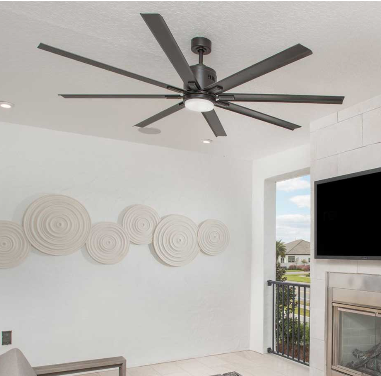
- Add a ceiling fan to the covered patio: A fan with an integrated LED light turns a warm porch into the best seat in the house on a July night.
- Keep the warmth consistent outside too: Matching color temperature across entry, path, and patio makes the whole exterior read as one finished design rather than a patchwork.
Should you change bulbs, upgrade fixtures, or both?
It depends on what is bothering you, and being honest about that question saves money. There are really three paths, and most projects are a mix of them.
- Change the bulbs: If your fixtures are in good shape and you simply want cooler-running, longer-lasting, more efficient light, this is the whole project. Match the color temperature to the room, confirm the dimmer pairing, and you’re done. This is the right move for a lot of homes and a lot of commercial spaces.
- Replace the fixture: If a fixture is dated, undersized, or just never felt right, summer is a fine time to replace it with an LED-ready fixture that fits the room. This is the path when the problem is the fixture itself, not the light it makes.
- Repair a part: There’s a middle path many people miss entirely. Sometimes the fixture is perfectly good, but a component inside it has failed: a ballast, a driver, a socket. Replacing an inexpensive part keeps a fixture you like running for the cost of a part rather than the cost of a renovation.
We can usually tell you which of the three you’re looking at in a short conversation, often from a photo. And when the honest answer is the least expensive one, that’s the answer you will get from us.
What should businesses and property managers know before switching?
For a business, the LED case is mostly about math and maintenance, and summer makes both more visible. A commercial space full of fixtures running all day is exactly where efficiency adds up fastest, and the cooling-season savings stack on top of the lighting savings. Fewer bulb changes mean fewer service calls and fewer ladders blocking aisles during business hours. Longer life means a lighting plan you set once and stop thinking about.
There’s also a comfort and appearance argument. Consistent, well-chosen LED light makes a retail floor look the way the merchandise deserves, makes an office feel productive instead of draining, and keeps a space looking maintained. Many older commercial setups are still running fluorescent tubes and ballasts that are perfect candidates for a retrofit, and we keep replacement lamps, ballasts, and drivers on hand for configurations most suppliers stopped carrying years ago.
Our roots are in commercial lighting distribution, so the trade side has been part of who we are from the beginning. We handle specification and quoting, lead-time tracking, replacement lamps and ballasts for older commercial setups, full Lutron control systems, and the trade pricing and account terms that let a real project run. If you manage a property or run a business, the fastest start is a call to (614) 262-8527 or an email to customerservice@paniclightingco.com with your fixture schedule or just your questions.
What are the most common mistakes people make switching to LED?
Almost every LED disappointment we hear about traces back to one of a few avoidable missteps. None of them are hard to sidestep once you know they exist.
- Picking the wrong color temperature. This is the big one. A number meant for a warehouse over a dining table is what makes people say they hate LED. Match the warmth to the room, and the complaint disappears.
- Ignoring the dimmer. Pairing a new LED with an old incandescent dimmer is the usual source of hum and flicker. Match the two, and it’s a non-issue.
- Chasing the cheapest bulb. Bargain LEDs can shift color over time and fail early, which undoes the whole reason you switched. A quality bulb holds its color and its life.
- Mixing color temperatures in one room. Two different warmth levels in the same space read as a mistake even when people can’t name why. Keep a room consistent.
- Forgetting the outdoors. Summer is the season to get exterior lighting right, and it’s the place LED pays off most. It’s easy to upgrade the kitchen and leave the patio on old bulbs.
- Buying brightness by watts. Watts no longer tell you how bright a bulb is. Read lumens for brightness and Kelvin for warmth, and the guesswork goes away.
How does summer affect your lighting choices?
Ohio summers are bright, long, and humid, and they change how lighting behaves in ways worth planning around. Inside, the long daylight means your interior light competes with strong evening sun for hours, so a fixture that looked fine in winter can feel weak or mismatched in June. The cooling season also rewards cool-running LED more than any other time of year, since every bulb that adds heat is working against your air conditioning.
Outside, summer is when exterior lighting actually gets used, and Ohio weather is demanding. Sun, storms, and humidity wear down lower-grade finishes fast, while true outdoor-rated fixtures hold up and, in the case of quality marine-grade finishes, often look better over the years as they age. Two practical reminders for almost every central Ohio project: lean a little warmer with color temperature than a designer in a dry southern climate might, because warm light reads as home here, and treat exterior lighting as year-round design rather than a summer accessory, since the path and driveway you light for June evenings are the same ones you navigate in the dark from October through April.
Where should you start an LED upgrade?
Start with a conversation, not a shopping cart. You do not need a finished plan or a list of fixtures. You need a sense of which rooms bother you and a willingness to talk through how you want them to feel. We take it from there, the same way we have for three generations on Silver Drive.
- Visit the showroom: 3251 Silver Drive in Columbus. See LED and traditional options lit side by side, compare color temperatures in person, and bring photos of your space. Open Tuesday to Friday, 7:30 a.m. to 5:00 p.m.
- Call us: (614) 262-8527. A phone conversation is a great first step if you want to think out loud before coming in.
- Email: customerservice@paniclightingco.com. Send photos, a fixture schedule, or a few questions, and we will respond with real input.
- For designers, builders, and electricians: ask about our trade program. Trade pricing, project quoting, lead-time tracking, and direct lines to the people who can move a project forward.
Summer is the right window for this. The daylight is long, the projects are easy to take on, and the savings start the same season you make the switch. When you’re ready, we would love to help you get it right the first time.
Final Thought: The Switch That Pays You Back All Summer
LED versus traditional is one of the few lighting decisions that gives back the moment you make it. Cooler rooms in July. A lower bill the same month. Outdoor light that runs all evening without a second thought. And bulbs you can stop thinking about for years. The only real risk is choosing the wrong warmth or the wrong dimmer, and those are exactly the things a short conversation prevents.
Three generations of one Columbus family have been helping people get lighting right since 1929. Whether you’re changing a few bulbs or rethinking a whole space for summer, we would love to help you make it the part of the project you remember loving.
- Call: (614) 262-8527
- Visit: 3251 Silver Drive, Columbus, OH 43224, Monday to Friday, 7:30 a.m. to 5:00 p.m.
- Online: paniclightingco.com