
Color temperature is the number in Kelvin printed on every bulb box, and it describes how warm or cool the light looks rather than how bright it is. Lower numbers read yellow and candle-like; higher numbers read white, then faintly blue. The reason one bulb can look right in the den and wrong in the kitchen has almost nothing to do with the bulb.
Quick Answer
Color temperature, written in Kelvin (K), describes the color appearance of the light a bulb produces. Around 2700K looks warm and yellow like an old incandescent, 3000K is a cleaner warm white, 3500K to 4100K reads neutral, and 5000K and above reads cool and daylight-like.
ENERGY STAR certifies lamps at a fixed set of nominal values, including 2700K, 3000K, 3500K, 4000/4100K, 5000K, and 6500K, and each one is a tolerance zone rather than a single exact color. Two bulbs marked 2700K can therefore look different from each other, and both can look different again once you move them into a room with oak floors or gray walls.
What Does LED Color Temperature Actually Mean?
Correlated color temperature is the temperature a theoretical black body would have to reach for its glow to most closely match the color of the light coming out of the bulb. That is the formal definition ENERGY STAR uses in its lamp certification criteria, and it is why heat language ended up attached to light that produces almost no heat.
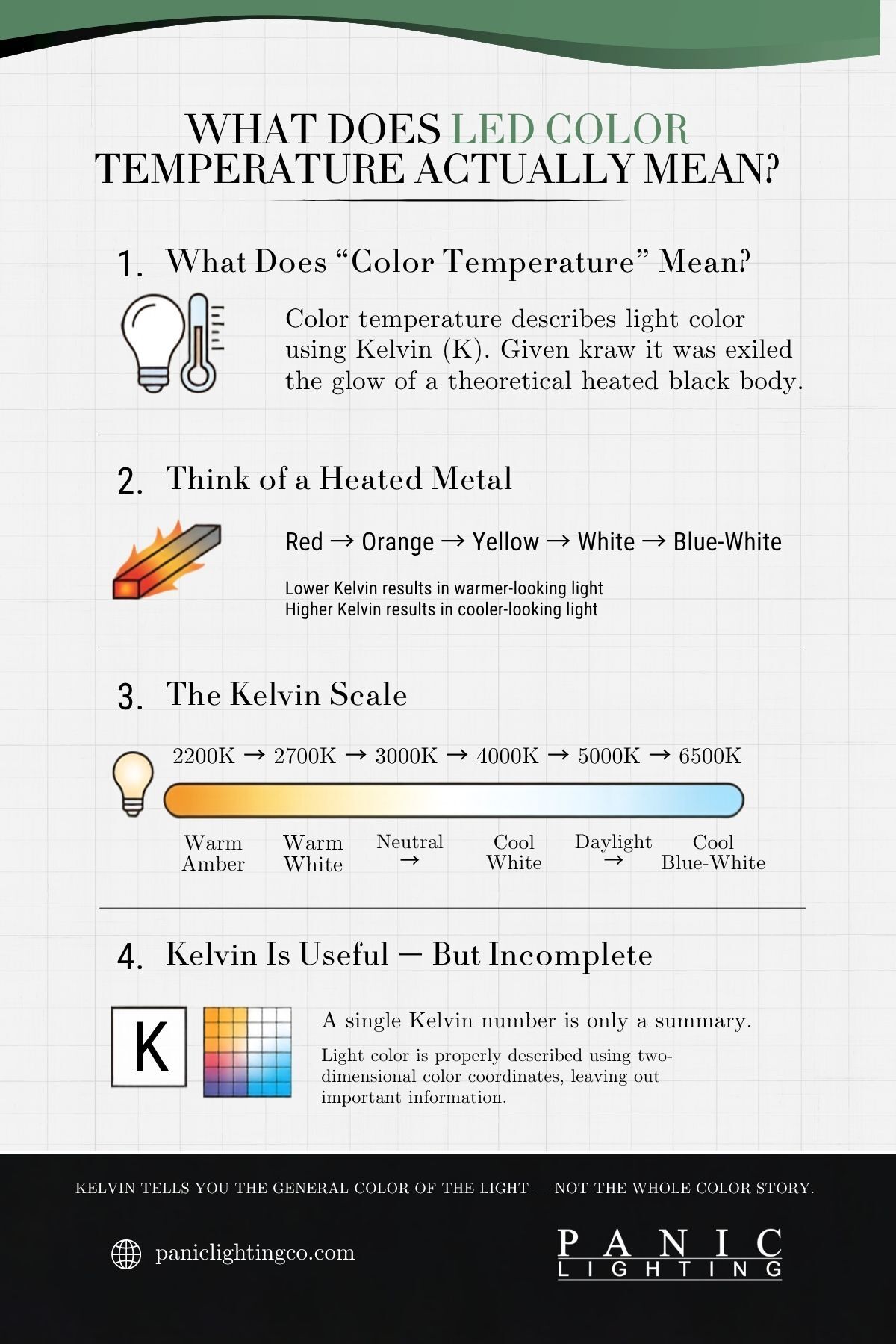
Heat an iron bar and it glows red, then orange, then yellow-white. The lower Kelvin numbers on a bulb box sit at the red end of that scale. Higher numbers sit past white, toward the blue of a clear midday sky.
Here is the part that trips people up. Kelvin is a single number standing in for a two-dimensional color coordinate, and the Department of Energy is blunt about the cost of that shortcut. Its LED Basics page notes that light color is properly described by color coordinates, and that condensing it down to a single correlated color temperature figure loses significant information along the way.
So the Kelvin figure is a summary. Useful, printed on every box, and incomplete.
Why Does the Same Bulb Look Different in Every Room?
Four things move the color you actually see, and only one of them is the bulb itself. Room surfaces bounce light back tinted with their own color, the fixture’s shade filters it, the bulb has a manufacturing tolerance rather than an exact color, and the bulb slowly shifts as it ages.
Move a 2700K lamp from a room with white walls to a room with walnut paneling and the light arriving at your eye genuinely is a different color.
The Number on the Box Is a Zone, Not a Point
To carry the ENERGY STAR mark, a solid-state lamp has to report one of the recognized nominal values, and nine out of ten sampled units have to land inside a seven-step MacAdam ellipse or an ANSI quadrangle around that value. A MacAdam ellipse is defined in the same document as the boundary at which a given share of people can tell two colors apart at all.
Seven steps is a generous target. It leaves room for two honestly labeled 2700K bulbs, from two brands or two production runs, to sit at visibly different points inside the same box on the shelf.
Your Walls, Floors and Cabinets Are Part of the Fixture
Every surface in the room reflects light with its own color mixed in. Warm oak, red brick, terracotta tile, and beige plaster all push the room warmer than the bulb is. Gray, slate blue, and cool white paint pull it the other way.
A bulb that looks perfect against the honey-toned trim in a German Village double will read noticeably cooler in a Dublin kitchen with white quartz and gray cabinet fronts, even at the identical Kelvin rating.
The Shade in Front of It Counts
A linen drum shade, an amber seeded glass globe, and a clear glass cylinder each do something different to the same source. Fabric and colored glass subtract wavelengths before the light reaches the room. This is why table and floor lamps and a ceiling fixture fitted with the same bulb rarely match.
Bulbs Drift as They Age
LEDs do not fail the way filaments did. The Department of Energy’s Building America Solution Center explains that LEDs undergo lumen depreciation over the life of the bulb, light output falls, and the color appearance can shift, and that a product’s rated lifetime is the point at which output is predicted to have dropped by 30 percent.
For certified lamps, drift is capped at a total distance of 0.007 on the CIE 1976 color diagram across the whole measured life. A five-year-old bulb next to a new one from the same brand is not a fair comparison.
The Kelvin Numbers You Will Actually See on a Box
Manufacturers do not pick arbitrary figures. The certification criteria list a specific set of nominal values, with 2200K and 2500K reserved for filament-style lamps.
| Nominal CCT | How it reads | Typical use |
|---|---|---|
| 2200K, 2500K | Candlelight, deep amber (filament-style lamps only) | Exposed-filament pendants, restaurant-style fixtures |
| 2700K | Warm yellow, the classic incandescent look | Living rooms, bedrooms, dining rooms |
| 3000K | Warm white, slightly cleaner and brighter-feeling | Kitchens, baths, hallways, outdoor entries |
| 3500K | Neutral, neither yellow nor blue | Laundry, home office, mudroom |
| 4000K / 4100K | Cool white, crisp | Garages, workshops, basement task areas |
| 5000K | Daylight white | Craft benches, reading, detailed close work |
| 6500K | Cool blue-white | Rarely right in a house |
The Building America guide draws the plain-English boundaries the same way: below 3000K reads as warm yellowish light, above 5000K reads as cool white, and natural daylight itself is typically identified at 4500K or higher. Its own shorthand is to look for 2700K to 3000K when you want warmth, 3500K to 4100K when you want a whiter room, and 5000K to 6500K when you want it cool.
CRI and R9: The Half of Light Quality Nobody Reads
Kelvin tells you what color the light is. It says nothing about what the light does to the color of everything else, and that second property is where cheap bulbs give themselves away.
Color rendering index, written CRI or Ra, scores how faithfully a source reproduces a set of reference colors compared with a reference light of the same color temperature. The Department of Energy recommends a minimum CRI of 80 for interior lighting and calls 90 or higher excellent color fidelity. ENERGY STAR builds that into its criteria: a certified lamp must have Ra of 80 or better, and no individual unit tested may fall below 75.
Then there is R9, which is the number worth hunting for and the one almost no consumer article mentions.
R9 measures rendering of strong, saturated red. It sits outside the eight pastel samples that get averaged into the headline CRI figure, so a bulb can post a respectable Ra of 82 while rendering deep reds badly. Red is doing quiet work everywhere in a house: skin tone, the warmth in cherry and walnut grain, brick, brass, terracotta, food on a plate, a red rug. Weak R9 is why a room can be bright and correctly warm on paper and still make everyone in it look tired.
The certification criteria require solid-state lamps to report an R9 above zero. Above zero is a floor, not a target. Good residential bulbs publish R9 values in the 50s and higher on their spec sheets, and the gap between R9 of 1 and R9 of 60, at the same 2700K, is obvious the moment you stand two lamps side by side.
There is an honest tradeoff to name here. Higher color rendering costs light output, and the certification criteria admit it directly: an omnidirectional lamp with CRI of 90 or above only has to reach 70 lumens per watt to qualify, while one below CRI 90 has to reach 80. You give up roughly an eighth of the output per watt to get the better color. In a bedroom or a dining room, that is a trade worth making every time.
What the Lighting Facts Label Leaves Off
Every general service bulb sold with a medium screw base carries an FTC Lighting Facts panel, and the Energy Labeling Rule is specific about what goes on it. The front of the package has to show brightness in lumens and an estimated annual energy cost, calculated at three hours of use a day and 11 cents per kilowatt-hour. The side or rear panel has to carry brightness, estimated yearly energy cost, life in years at that same three hours a day, wattage, and “Light Appearance,” the correlated color temperature shown as a number and a marker on a scale running from 2,600K on the left to 6,600K on the right.
Read that list again and notice what is missing.
CRI is not on it. R9 is nowhere near it. Neither is dimmer compatibility, beam angle, or the color bin the unit actually landed in. The label was written to help shoppers stop buying by watts, and at that job it works. For color quality, you have to go to the manufacturer’s spec sheet, the ENERGY STAR certified product listing, or a showroom where the bulb is already lit.
One more thing the label quietly fixes: the lumen equivalents. The ENERGY STAR light bulb purchasing guide puts a 40W incandescent at 450 lumens, a 60W at 800, a 75W at 1,100, a 100W at 1,600 and a 150W at 2,600.
Buy by the lumen number, then choose the Kelvin number separately. They are two independent decisions, and people routinely treat them as one.
Picking a Kelvin Number Room by Room
Start from what the room is for, not from what looks good on a shelf display.
| Room | Suggested CCT | Reasoning |
|---|---|---|
| Living room, family room | 2700K | Matches the incandescent look people associate with evening comfort |
| Bedroom | 2700K, dimmable | Warm and low in the evening; dim-to-warm fixtures drop the CCT as they dim |
| Dining room | 2700K, high CRI with strong R9 | Food and faces both depend on red rendering |
| Kitchen | 3000K, task areas up to 3500K | Clean enough to see by, still warm against wood cabinets |
| Bathroom vanity | 3000K to 3500K, CRI 90+ | Makeup and shaving need honest skin tone, not a blue cast |
| Home office | 3500K | Neutral light keeps paper white and screens readable |
| Laundry, mudroom | 3500K to 4000K | Stain spotting and sorting benefit from a cooler, flatter light |
| Garage, workshop | 4000K to 5000K | Detail work wins over ambience |
| Front porch, exterior | 2700K to 3000K | Warm light flatters brick and siding and reads as welcoming from the street |
A couple of rows in that table catch people out. Hallways and entries lit by wall sconces want the same warm number as the rooms they connect, because you see both at once from the doorway. And porch and post lights are the one place where going cool actively hurts: 4000K on a brick facade reads as a parking lot.
Our own bias, after decades of watching people stand under fixtures on Silver Drive: most Columbus homes go one step too cool, then blame the fixture.
Short Winter Days Change How Warm Light Reads
A Kelvin choice that feels perfect in July can feel wrong in January, and there is a straightforward reason.
Sunrise and sunset for Columbus at the two solstices, in local clock time:
| Date | Sunrise | Sunset | Daylight |
|---|---|---|---|
| 21 June 2026 | 6:03 a.m. EDT | 9:03 p.m. EDT | 15h 00m |
| 21 December 2026 | 7:50 a.m. EST | 5:09 p.m. EST | 9h 19m |
A swing of five hours and forty-one minutes, and almost all of it comes off the evening.
For most of a Columbus winter, your electric light is not competing with daylight through the windows. It is the only light in the room. Anything cool reads clinical against a dark window at 5:30 in the afternoon, while the same 4000K downlight looked crisp and correct in May with the back door open.
Two habits help. Put the coolest fixtures where you only work in daylight hours, like a garage or a basement bench. And give every warm-lit living space a dimmer, because dropping the output of a 2700K source in a dark house does more for the room than any Kelvin change would.
Homeowners in Clintonville, Grandview Heights, and Upper Arlington deal with a second wrinkle: older houses with plaster walls, dark woodwork, and small windows soak up light. Those rooms usually want more lumens at the same warm Kelvin rather than a cooler bulb.
Mixing Color Temperatures in One Open Floor Plan
Keep every fixture on a single sightline at one nominal CCT. Kitchen, dining and living areas that all see each other should match, because a 3000K island next to a 2700K pendant run reads as a mistake even to people who could not name why. If you are working out an island pendant run, our guide to how high to hang pendant lights over a kitchen island covers the placement side of the same job.
Different rooms behind different doorways can differ freely. Nobody stands in the hallway comparing the laundry to the bedroom.
Two features are worth knowing by name when you shop. Color-shifting dimmable fixtures, usually sold as dim-to-warm, automatically drop the color temperature as they dim, which is what an incandescent did naturally. White-tunable products let you move across a range of color temperatures on a switch or an app. Both are defined in the ENERGY STAR criteria, and both solve the open-plan problem in a way a fixed bulb cannot.
One last technical note for recessed cans and spots. Directional lamps have a color angular uniformity requirement, capping chromaticity variation across the beam at 0.006 on the same CIE diagram, because a downlight whose center reads warmer than its edge will scallop a wall in two different colors. It is a real defect; it is common in uncertified products, and it is invisible until the fixture is installed and pointed at a wall.
Bring Your Color Temperature Shortlist to the Showroom
Write down three things before you buy:
- The lumens you need
- The Kelvin number you want
- The CRI and R9 from the spec sheet
Those three settle almost every lighting complaint we hear. If a spec sheet will not tell you its R9, that silence is an answer.
The rest is worth seeing lit. Standing under a dining room chandelier at 2700K with CRI 90 against the same fixture at 3000K with CRI 80 takes about ten seconds to judge, and it is genuinely difficult to judge from a product photo.
We keep the fixtures burning and the LED bulbs we stock on the wall so you can hold two side by side. Bring a paint chip, a cabinet door, or a piece of your countertop, and come see it under real light. Our showroom on Silver Drive has been lighting Columbus houses since 1929.