
It’s the shift you feel before you can name it. As the days start pulling in, the daylight that used to stretch past nine starts folding in a little earlier every week. You turn the kitchen lights on before dinner instead of after. The lamp in the corner comes on while you’re still finishing the dishes. And the lighting you barely thought about all summer, back when the sun did most of the work, is suddenly the thing carrying your evenings again. That’s usually when the question surfaces: is it finally time to do something about it?
If you’ve been circling that question for a while, you’re in good company. Lighting is one of those upgrades people put off for years, not because it’s hard, but because it never feels urgent until the day it does. A fixture you’ve meant to replace since you moved in. A kitchen that has always been a little dim. A dimmer that hums every time you touch it. None of it stops you from living your life, so it waits. Then the evenings get longer indoors, and you notice all of it at once.
This guide is about knowing when that moment has actually arrived, and what to do once it has. Not the pressure version, where every sign means you need to spend money today. The honest version, where some of these are worth fixing now, and some can wait, and the whole point is being able to tell the difference. We’ll walk through the signs, what being ready really looks like, how to choose without getting overwhelmed, and what happens when you come in.
It’s written for homeowners, business owners, contractors, and property managers across Columbus and central Ohio, from Clintonville, Worthington, and Bexley to Upper Arlington, Dublin, New Albany, Westerville, Hilliard, Gahanna, German Village, the Short North, and everywhere in between. We’ve been having this conversation in our showroom on Silver Drive for three generations. Read what helps, skip what doesn’t, and bring us the rest.
Why do we put off upgrading our lighting?
Because lighting almost never breaks in a way that forces your hand. A leaky roof gets fixed. A dead furnace gets replaced the same week. But a room that’s a little too dim, or a fixture that’s ten years out of date, just keeps working well enough to ignore. It does its job badly and quietly, and quiet problems are the easiest ones to leave for later.
There’s also the overwhelm. The moment you start looking, the options multiply. Fixtures, finishes, bulbs, color temperatures, dimmers, brands you’ve never heard of. It’s easy to open a browser tab, feel the size of the decision, and close it again. Putting it off starts to feel safer than getting it wrong.
And plenty of people have gotten it wrong before. They bought a bulb that turned the living room a cold blue. They installed a fixture that looked bigger online than it does over the actual table. One bad experience teaches you that lighting is a gamble, so you stop rolling the dice. None of that means the upgrade isn’t worth it. It means the process needs to be different, with someone who narrows the choices instead of piling on more of them.
What tends to break the stall is the season. As the evenings pull in and the days get shorter, you spend far more hours under your own lighting than you did all summer, and the things that were easy to overlook when the sun did the work are right in front of you again. That’s not a reason to panic. It’s just a natural moment to finally sort it out before the long indoor stretch ahead.
What are the signs it’s time to upgrade your lighting?
Most people know something is off long before they can say what. Here are the signs we hear about most, and none of them mean anything is wrong with you or your home. They’re common, they’re normal, and they’re fixable, usually more simply than you’d expect.
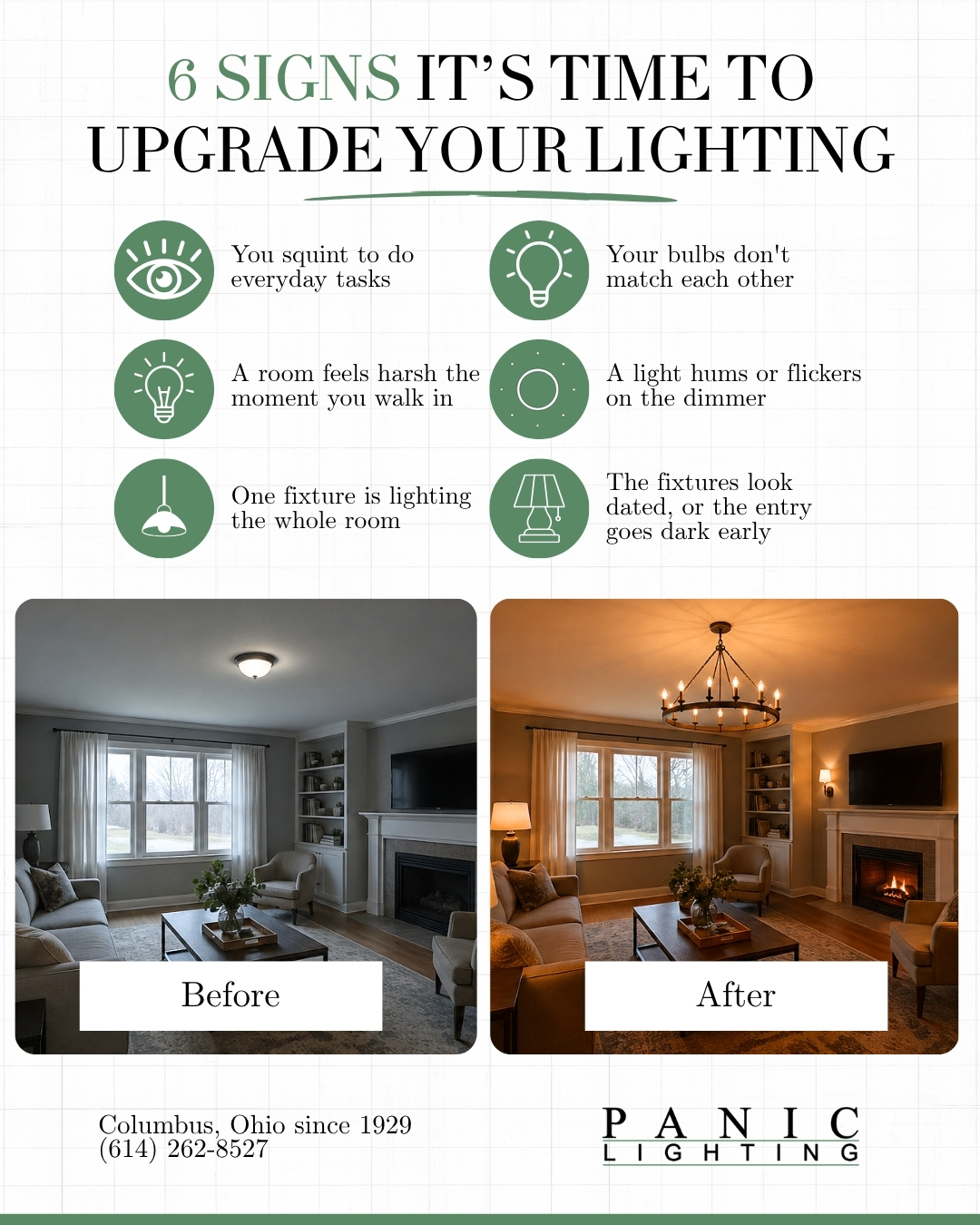
- You’re squinting to do ordinary things: Reading a recipe on the counter, doing your makeup at the mirror, working at your desk after four o’clock. If you lean in or grab a lamp to get through a normal task, the room is underlit for how you actually use it.
- A room feels harsh the second you walk in: Too bright, too flat, too blue. Light that makes a space feel like a waiting room instead of a home is almost always the wrong color temperature or a single unshaded source doing all the work.
- One fixture is doing the job of three: A lone ceiling light in the center of the room, throwing shadows into every corner, is the most common lighting problem there is. Rooms are meant to be lit in layers, not from a single point.
- Your bulbs never match: One’s warm, one’s cold, one’s brighter than the rest. Mismatched color temperature reads as off even when people can’t put a finger on why.
- Something hums, flickers, or buzzes: Usually a dimmer and a bulb that were never designed to speak the same language. It tends to be a five-minute fix once you know that’s the cause.
- The fixtures just look dated: Finishes that have gone dull, styles that belong to a previous decade, a chandelier you’ve never actually liked. Sometimes the light is fine, and the fixture is the problem.
- The outside of your home goes dark too early: Entry, path, and driveway lighting matters more as the evenings arrive sooner. A dark front walk once it’s dark by dinner is both a safety issue and the first thing a guest sees.
If one or two of these sound familiar, that’s normal, and it can wait until you’re ready. If most of the list sounds like your house, that’s usually a sign the lighting was never really planned, just accumulated over the years, and a proper upgrade will change how the whole place feels.
When does bad lighting start to cost you more than it should?
Most lighting problems are comfort problems, and comfort is reason enough to fix them. But a few of them quietly cost money, and those are the ones worth moving up your list.
The clearest one is old, inefficient bulbs. Incandescent and halogen bulbs turn most of their energy into heat instead of light, so you pay to run them and, in the warmer months, pay again to cool the room they heated. Switching those to LED is one of the few upgrades that starts paying you back the same month you make it.
There’s also the cost of waiting on a fixture that’s actually failing. A socket that’s gone intermittent, a ballast on its way out, an outdoor fixture that’s slowly corroding. Caught early, it’s often an inexpensive part. Left alone, it can take the whole fixture with it, and a small repair becomes a full replacement.
And there’s a softer cost that’s real even though it never shows up on a bill. A business with tired, uneven lighting looks tired to its customers. An office that’s dim by mid-afternoon wears people down by the end of the day. A home with a dark entry and mismatched rooms never quite feels finished. Good lighting is one of the least expensive ways to make a space feel cared for, and that impression does its own quiet work.
What does being ready to upgrade actually look like?
Here’s the part that surprises people. You don’t need a plan, a budget, a fixture list, or a finished idea to be ready. Ready is much simpler than that.
Ready is knowing which rooms bother you. Not how to fix them, just which ones. The kitchen that’s always dim. The living room that only has the one harsh light. The patio you stopped using after dark. If you can name the spaces that aren’t working, you already have everything you need to start.
Ready is being willing to talk about how you want a room to feel. That’s the real starting point for us, and it’s a question most people have never been asked. Do you want the kitchen bright and clear for cooking, or soft and warm for the end of the night? Both are possible, and the answer shapes everything that comes after.
And ready is being fine with not knowing the technical part. That’s our job. You don’t have to understand lumens, Kelvin, or dimmer compatibility to make a good decision. You need someone to translate what you want into what to buy, which is the conversation we have every day. Know the rooms and the feeling, and you’re ready. The rest we handle together.
Why does clarity matter more than having more options?
Because more options are usually the problem, not the solution. Walk into a big-box aisle or open a lighting website, and you’re met with a wall of nearly identical choices, none of them labeled in a way that helps you decide. That isn’t freedom. That’s where good projects stall out.
What actually moves a decision forward is someone narrowing it. The right warmth for the room you’re lighting. The right size for the table or the ceiling height. The two or three fixtures worth considering instead of the two hundred that aren’t. A choice you can actually make, rather than an ocean you have to cross on your own.
That’s the difference a real showroom and a real conversation make. You see fixtures lit in person, compare color temperatures side by side, and get honest input from people who work with this every day. You leave with a clear path to the right answer instead of more to sort through. For a decision that shapes how your home feels every single evening, that clarity is worth more than endless choice.
How do you evaluate lighting without getting overwhelmed?
Start by ignoring almost everything. You don’t have to become an expert to make a confident choice. You need to read two numbers and answer two questions, and you can skip the rest.
The two numbers are printed on every bulb. Lumens tell you how bright it is, and the higher the number, the more light you get. Kelvin tells you the warmth, where lower numbers are warm and golden and higher numbers are cool and crisp. Watts used to be how everyone shopped, but with LED they barely matter anymore. Read lumens for brightness and Kelvin for warmth, and most of the confusion in the bulb aisle simply disappears.
The two questions are about the room. First, how do you actually use it, and at what time of day? A kitchen at seven in the morning and a dining room at eight at night want different light. Match the light to real life, not to a catalog photo. Second, is one source doing all the work? If it is, the fix is usually layering: add a lamp, a sconce, or some task lighting so the room has depth instead of one flat wash.
That’s the whole method for most homes. Two numbers, two questions. When it gets more involved- a stubborn dimmer, a tricky ceiling height, a commercial space with dozens of fixtures- that’s exactly when it helps to bring it to someone. You don’t have to hold all of it in your head. You just have to know enough to start the conversation.
Do you need a repair, a replacement, or a real upgrade?
This is the question that saves the most money, and it’s the one people skip. There are three different paths here, and they cost very different things. Knowing which one you’re on before you shop keeps you from spending on a problem that never needed it.
- A repair: Sometimes the fixture is perfectly good, and a single part has failed. A socket, a ballast, a driver, a switch. Replacing an inexpensive component keeps a fixture you like running for the cost of the part, not the cost of a renovation. This is the path people miss most often, and we keep parts on hand for fixtures most stores stopped supporting years ago.
- A replacement: Sometimes the fixture is dated, undersized, or was never right for the room, and the honest move is to swap it for one that fits. This is a like-for-like change with a better result: the same spot on the ceiling, a fixture that finally belongs there.
- A real upgrade: And sometimes the room deserves a rethink rather than a swap. Not what was here before, but what has this room never had? Layered light, the right warmth, a dimmer on anything that runs in the evening. This is the path when you want the space to feel genuinely different rather than simply newer.
Most projects are a mix of the three, and you rarely know which is which from a photo alone, though a photo is a great place to start. We’ll tell you honestly which one you’re looking at, even when the least expensive answer is the right one. After three generations of doing this, we’d rather keep your trust than sell you a fixture you didn’t need.
What is the best lighting to upgrade, room by room?
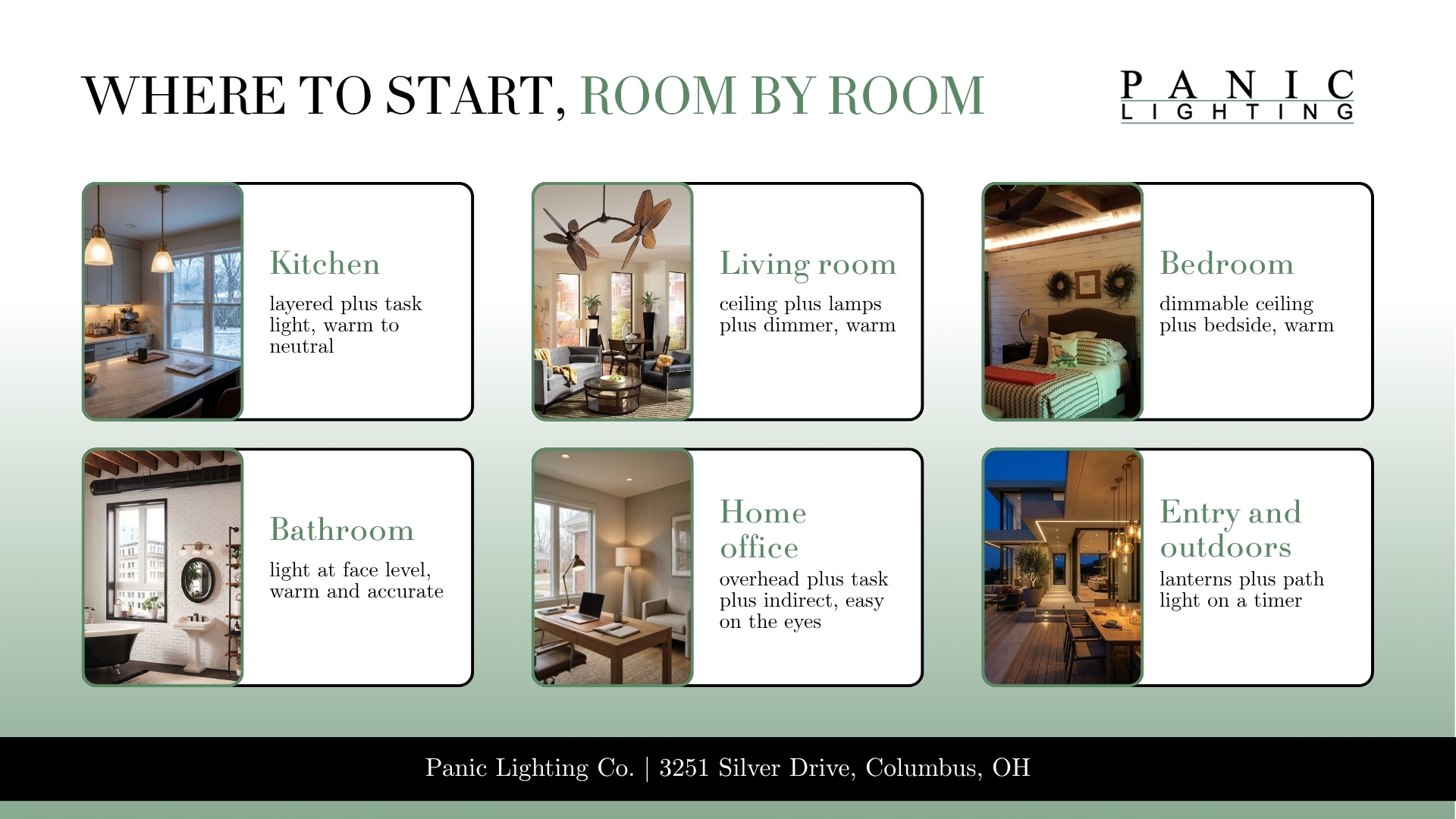
Every room benefits from the same three ideas: layered light, the right warmth, and a dimmer on anything you use in the evening. What changes room to room is the fixtures and where the light needs to land.
Kitchen
The kitchen works best with three things together: overhead light that fills the room, focused task light over the counters and sink, and one fixture with some personality over an island or table. Keep the color temperature warm to neutral so food and finishes look right. As the evenings arrive earlier, the kitchen goes back to being the room you light first and use longest, which makes it the highest-value place to start.
Living room
Living rooms suffer most from a single overhead fixture trying to do everything. Layer it: a ceiling fixture for general light, a couple of lamps for warmth and reading, and a dimmer so the room can move from bright on a Saturday morning to soft on a dark evening. Warm LED on a good dimmer is what makes this room feel right for company and quiet nights alike.
Bedroom
A bedroom should feel restful, not bright. A dimmable ceiling fixture, two bedside lamps or sconces, and warm bulbs do the job. Keep the color temperatures warm here especially, since cooler light in the evening works against winding down. As the nights get longer, this is a room where warm, dimmable light earns its keep every single day.
Bathroom
The most common bathroom mistake is a single fixture above the vanity, which throws hard shadows under the eyes and chin. The fix is light at face level, with sconces flanking the mirror or a vanity bar, plus a soft overhead fill on a dimmer. Choose warm, high-quality LED and the right bathroom fixtures so skin tones read accurately in the mirror, which matters most on the dark mornings ahead.
Home office
A home office should feel productive without feeling like a conference room. Overhead light for the space, focused task light at the desk, and one indirect light from a corner to soften it. Skip the old fluorescent panels, which flatten everything and tire your eyes by mid-afternoon, right when the daylight is already fading.
Entry and outdoors
This is the upgrade people forget until the evenings get dark, and then it matters every night. Entry lanterns, path lights, and a lit driveway do double duty: they make the home feel finished, and they keep the walk to the door safe once it’s dark by dinnertime. Hinkley and Kichler are our two go-to lines for Ohio exteriors because their finishes hold up through real weather. Put it on a photocell or timer, and it takes care of itself all season.
What should businesses and property managers look at first?
For a business, the signal to upgrade is usually maintenance and appearance rather than a single dead light. If your team is changing bulbs often, if fixtures are humming or flickering, or if a floor looks dim and uneven to customers, the lighting is quietly costing you in service calls and impressions at the same time.
The first thing worth looking at is anything still running on old fluorescent tubes and ballasts. Those are the fixtures where an LED retrofit pays off fastest: in energy, in far fewer bulb changes, and in a consistent look across the whole space. Fewer service calls, fewer ladders blocking aisles during business hours, and a lighting plan you set once and stop thinking about.
Our roots are in commercial lighting distribution, so the trade side has been part of who we are from the beginning. We handle specification and quoting, replacement lamps and ballasts for older commercial setups, full Lutron control systems, and the trade pricing and account terms that let a real project run. If you manage a property or run a business, the fastest start is a call to (614) 262-8527 or an email to customerservice@paniclightingco.com with your fixture schedule, or just your questions.
What happens when you visit the showroom?
If you’ve never been to a real lighting showroom, the biggest surprise is how little pressure there is. You’re not walking into a sale. You’re walking into a room where lighting is lit the way it’ll actually look, and where someone’s whole job is to help you think it through.
Here’s roughly how a visit goes. Bring photos of your rooms if you have them, even quick phone shots, and bring the questions you’ve been sitting on. We’ll ask how you use the spaces and how you want them to feel. Then we’ll show you options lit in person, so you can compare warm against cool and one fixture against another with your own eyes instead of guessing from a screen. If dimmers are part of the project, bring the dimmer or a photo of it, and we’ll tell you exactly what to pair with it.
You don’t have to buy anything that day, and you don’t have to decide everything at once. Plenty of people come in, look, ask, and go home to think it over, and that’s completely fine. The point of the visit is to leave with clarity, whether that’s a fixture in hand or just a clear idea of what you want next.
How do we help you decide without any pressure?
The short version: we tell you the truth, even when it’s the cheaper answer. If a room needs an inexpensive part instead of a new fixture, that’s what we’ll say. If the honest move is to change the bulbs and keep the fixtures you already have, we’ll tell you that too. We’ve been in the same Columbus neighborhood since 1929, and a business doesn’t last three generations by talking people into things they don’t need.
What that looks like day to day is simple. We narrow the choices instead of adding to them. We match the light to how you live, not to whatever’s on promotion. We keep parts and bulbs on hand for fixtures other stores gave up on. And we’re glad to be a first step and not a commitment, whether you’re ready to redo a whole home or just want to understand one stubborn room before you do anything at all.
It’s the part people tend to name in their reviews, right down to the team member who found them the right part to shorten a chandelier or tracked down a piece they hadn’t seen anywhere else in Columbus. Getting it right the first time has been the point here for a long time. That holds whether you spend a little or a lot, and it’s the reason people come back and send their neighbors.
How do you get the most out of new lighting once it’s in?
A few small habits keep new lighting looking and working its best, and none of them take any real effort.
- Keep a room’s warmth consistent: When you replace a bulb down the road, match the Kelvin number to the others in the room so nothing drifts warm or cool. Jot the number down, or keep a spare, so it’s easy to get right.
- Use your dimmers: A fixture on a dimmer lasts longer and lets one room do several jobs, bright for cleaning, soft for the evening. If a bulb hums or won’t dim smoothly, that’s the pairing, not a defect, and it’s an easy fix.
- Give outdoor fixtures a quick seasonal wipe: Finishes hold up far better with the occasional cleaning, especially heading into Ohio’s wet, salty winter. Quality outdoor-rated fixtures are built for it, but a little care goes a long way.
- Keep a couple of spares on the shelf: For the bulbs you use most, a spare or two turns a burned-out light into a two-minute swap instead of a trip out, and you already know it’ll match.
And when something does need a part, or you’re ready for the next room, you know where we are. Lighting is rarely a one-and-done project, and we’re happy to be the place you come back to.
Serving Columbus and central Ohio
Panic Lighting Co. has served central Ohio from the same Silver Drive showroom for three generations. Wherever you are in the area, you’re within easy reach for a visit, a pickup, or a quick question.
- Columbus and the near neighborhoods: Clintonville, German Village, the Short North, Bexley, Upper Arlington, and the Grandview-area homes.
- North and northeast: Worthington, Westerville, New Albany, and Gahanna.
- West and northwest: Dublin, Hilliard, and the surrounding communities.
- And the rest of central Ohio: if you can get to Silver Drive, we’re glad to help, homeowner or contractor, one bulb or one hundred.
Where should you start?
Start with a conversation, not a shopping cart. You don’t need a finished plan or a list of fixtures. You need a sense of which rooms bother you and a willingness to talk through how you want them to feel. We’ll take it from there.
- Visit the showroom: 3251 Silver Drive in Columbus. See fixtures and color temperatures lit in person, and bring photos of your space. Open Tuesday to Friday, 7:30 a.m. to 5:00 p.m.
- Call us: (614) 262-8527. A phone conversation is a great first step if you’d rather think out loud before coming in.
- Email: customerservice@paniclightingco.com. Send photos, a fixture schedule, or a few questions, and we’ll respond with real input.
- For designers, builders, and electricians: ask about our trade program. Trade pricing, project quoting, and direct lines to the people who can move a project forward..
Final Thought: The Season to Finally Sort It Out
You’ll know it’s time by how often you notice it. The dim counter, the harsh corner, the fixture you’ve never liked, the dark walk to the front door. Once the evenings pull in and you’re living under your lighting again, those small annoyances stop being so easy to ignore. The good news is that most of them are simpler and less expensive to fix than people expect, and none of them require you to have it all figured out first.
Three generations of one Columbus family have been helping people get lighting right since 1929. Whether it’s one stubborn room or a whole home you’re finally ready to rethink, come see it lit in person and talk it through. No pressure, just an honest path to the answer.
- Call: (614) 262-8527
- Visit: 3251 Silver Drive, Columbus, OH 43224, Tuesday to Friday, 7:30 a.m. to 5:00 p.m.
- Online: paniclightingco.com