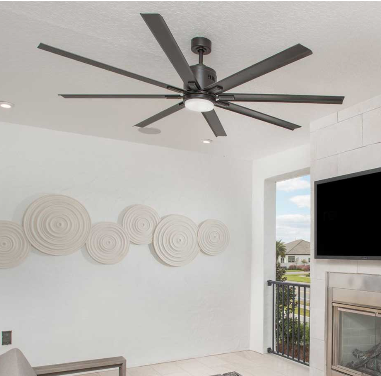

Ceiling fans are the fixture people research the least and complain about the most. We hear it in the showroom every week. The fan wobbles. The fan hums. The fan moves no air. The fan looks like it came with the house in 1994, because it did. Almost every one of those complaints traces back to the same root cause: the fan was bought by diameter and price, and nothing else.
There’s more to it, but not much more. Give us ten minutes, and you’ll know how to choose a ceiling fan properly, which is something most people are never actually taught. This guide comes from the floor of Panic Lighting in Columbus, Ohio, where we’ve been helping central Ohio families pick fixtures since 1929, and where fans have quietly become one of our favorite categories to sell, because the good ones got really good.
What size ceiling fan do I need?
Size is the first decision and the one most people get wrong, almost always in the same direction: too small. A fan that’s undersized for the room has to spin faster to move the same air, which means more noise, more wobble, and a fixture that looks lost on the ceiling.
Measure the room’s longer wall, then use this as your starting point:
- Under 8 ft rooms (small bath, walk-in closet, hallway): 29 to 36 inch fan
- Rooms up to 12 ft (bedroom, office, breakfast nook): 42- to 48-inch fan
- Rooms 12 to 15 ft (most bedrooms and living rooms): 52- to 56-inch fan
- Rooms 15 to 18 ft (family rooms, large primary suites): 60-inch fan
- Rooms over 18 ft (great rooms, covered patios): 62 to 72 inches, or two fans
So for the classic question, a 12 by 12 bedroom wants a 48- to 52-inch fan. Not the 42-inch builder special. And here’s our honest, slightly lopsided take after decades of doing this: when you’re between two sizes, go up. We have replaced hundreds of fans that were too small. We can count the fans we’ve replaced for being too big on one hand.
Ceiling height decides the mount. Standard mounting works for 8-foot ceilings. For 9 feet and up, add a downrod, roughly 6 inches of rod for every foot of ceiling over 8, so the blades end up 8 to 9 feet off the floor where they actually move air onto people. Vaulted ceiling? You need a sloped-ceiling adapter, and yes, we stock them.
Browse our full range of indoor ceiling fans to see current sizes and styles.
CFM: the number that matters more than blade count
Here’s the thing nobody tells you at a big-box store. Blade count is mostly cosmetic. Three blades, five blades, it barely changes performance. The number that tells you whether a fan actually works is CFM, cubic feet of air moved per minute, and it’s printed on the box of every fan sold in the US.
A cheap fan might move 3,000 CFM. A good one moves 5,000 to 7,000. For a large family room, look for 6,000 CFM or better. This single number explains why the $89 fan and the $400 fan that look similar in a photo are completely different machines in your house.
The second spec worth knowing is the motor. DC motors are the meaningful upgrade of the last decade: they use about 70 percent less energy, run silently, offer more speeds, and reverse from the remote instead of a fiddly switch on the housing. Brands like Fanimation, Hinkley, Kichler, Minka-Aire, and Matthews Fan Company build DC fans that will outlast the room’s next two paint colors. We carry all of them.
Ceiling fans with lights: worth it or not?
Usually yes, with one caveat. In bedrooms and family rooms, the fan often occupies the ceiling’s only center junction box, so a fan with an integrated LED light lets one fixture do both jobs. Modern integrated LEDs solved the old problems. The light is no longer an afterthought bulb behind frosted glass. Many current fans put out 1,500 to 2,000 lumens of dimmable, warm light, which handles general lighting in a bedroom easily.
The caveat: a fan light should rarely be the room’s only light. Layer it the way you’d layer any room: fan light overhead, lamps at eye level, warm bulbs throughout. We covered the layering approach for every room in our guide to choosing the right lighting for your Columbus home, and it applies double in rooms with a fan.
One more strong opinion, since you’re here: choose a fan light with a color temperature of 2700K to 3000K, and confirm the fan is dimmer-compatible before you buy. The number of fans returned over a cool blue light or a flickering dimmer is larger than it should be. Both problems are avoidable at purchase, and both are exactly the kind of thing we check for you before a fan leaves our store.

Outdoor ceiling fans: ratings actually matter here
Can you put an indoor fan on your porch? No. Please don’t. Indoor fans on porches rust, wobble, and fail, sometimes within a single Ohio summer. Outdoor fans come in two ratings, and the difference decides where each can live:
- Damp-rated: covered areas that see humidity but not direct water. Covered porches, screened rooms, sunrooms, garages.
- Wet-rated: anywhere. Open pergolas, gazebos, exposed patios. Sealed motors, rust-proof hardware, all-weather blades. You can literally hose them off.
For central Ohio, our rule is simple: when in doubt, buy wet-rated. Ohio humidity, blowing rain, and freeze-thaw winters punish borderline fixtures, and the price difference between damp and wet-rated has narrowed to almost nothing. Hinkley’s outdoor fan line is the one we recommend most for exposed installations, and their finishes genuinely hold up here. See the current selection of outdoor ceiling fans or come compare them side by side in the showroom.
An outdoor fan also pays off longer than people expect. It extends patio season on both ends, keeping August evenings comfortable and, run on low in reverse, gently pushing warmth around a covered space in October.
Which direction should the fan spin, and does it help in winter?
Counterclockwise in summer, clockwise in winter. In summer, counterclockwise rotation pushes air straight down and creates a wind-chill effect that makes a room feel several degrees cooler, which lets you nudge the thermostat up without anyone noticing. In winter, flip the fan to clockwise on its lowest speed. Warm air stacks at the ceiling, especially in vaulted great rooms, and the reversed fan pulls it back down along the walls without creating a draft.
That winter trick is genuinely underused in Ohio. Heating dominates our energy bills, and a great room with a 14-foot ceiling holds a surprising amount of paid-for heat up where nobody lives. If your current fan doesn’t have an easy reverse function, that alone is a decent reason to upgrade to a DC-motor fan with reverse on the remote.
Style: the fan finally caught up to the rest of the room
For decades, ceiling fans were where design went to die. That’s over. Today’s fans come in every language the lighting world speaks: matte black minimalist fans with three sleek blades, natural wood and rattan for organic modern rooms, aged brass and bronze that pair with the warm-metal fixtures everywhere right now, and windmill-style fans with real presence for farmhouse great rooms.
The trick is treating the fan as part of the room’s metal-and-material story rather than an appliance. If your chandeliers and sconces are aged brass, a matching or complementary fan finish makes the whole room read as designed. Bring photos of your space and your existing fixtures, and we’ll narrow forty options down to three in a few minutes. That part is fun for us. It’s what a real lighting and fan showroom is for.
Quick answers to the questions we hear most at the counter
Wobble is rarely the fan’s fault on a quality unit; it’s the mounting box. Fans need a fan-rated box, and a lot of older Columbus homes have fans hanging from boxes meant for a light fixture. Any electrician can swap it in under an hour.
Humming usually means an AC-motor fan on an incompatible speed control or dimmer. DC fans with their own remotes sidestep the entire problem.
Remotes vs. wall controls vs. smart: all three are fine. Just decide before purchase, not after, because retrofitting controls is where costs sneak in. Many of the fans we carry now work with the same Lutron ecosystem as your dimmers, which keeps everything on one system.
Come stand under a few fans before you buy one
A fan is like a chandelier in one important way: photos lie about scale. A 60-inch fan sounds enormous and looks right. A 44-inch fan sounds reasonable and looks like a toy in most living rooms. Standing under fixtures in person settles the question in seconds.
Visit Panic Lighting at 3251 Silver Drive, Columbus, OH 43224, Tuesday through Friday, 7:30 a.m. to 5:00 p.m. Bring your room dimensions and ceiling height, or just photos on your phone, and we’ll size the fan, match the finish to your other fixtures, and confirm the ratings and controls so nothing has to come back.
Call (614) 262-8527 or email customerservice@paniclightingco.com with questions. Contractors, builders, and designers can ask for trade pricing through our trade program. Family-owned in Columbus since 1929, and yes, we take the fan category as seriously as the chandeliers.