
A mono-point is one aimable head on its own small canopy, wired to a single junction box. Track is a powered rail carrying several heads that slide along it. The choice between them is really a question about the future: whether what you are lighting is going to stay exactly where it is.
TL;DR
Mono-points suit a fixed target. One head, one box, nothing sticking out along the ceiling, and it looks deliberate rather than left over.
A rail suits a changing one. Heads slide along the rail, come off, get added, and re-aim in seconds, which is why galleries and retail run it and why a room where the art rotates should too. Track heads are not universal: the three common rail standards are named after Halo, Juno, and Lightolier, and heads built for one do not fit another. Wall-mounted heads in a corridor have a further constraint, because the ADA Standards cap how far an object between 27 and 80 inches above the floor may stick out into a circulation path.
One Box, or a Run of Power
Everything else follows from this difference.
A mono-point takes power from a single junction box and puts one head on it. The canopy is small, often three or four inches across, and once it is up, the head aims within its own range and nowhere else. If the target moves, the fixture does not.
A rail takes power at one point and distributes it along its length. Heads clip on anywhere, in any number up to the system’s rating, and they come off just as easily. That is the entire argument for it.
| Mono-point | Track | |
| Power | one junction box per head | one feed for the whole run |
| Adding a second light | new box, new wiring | clip another head on |
| Re-aiming to a new spot | Limited to the head’s travel | slide the head, then aim |
| Ceiling appearance | small canopy, discreet | a visible rail |
| Best for | a fixed target | a changing one |
Cost runs the way you would expect at small numbers and then reverses. A single light is cheaper as a mono-point. Four lights in a line are almost always cheaper as track, because you are paying for one feed instead of four boxes and four cable runs.
H, J and L: Track Heads Are Not Universal
This is the mistake that costs people money, and it happens after the track is already up.
There are three common rail standards in North American track, and the letters come from the manufacturers that established them: H for Halo, J for Juno, L for Lightolier. They differ in the number of conductors, the spacing of the contacts inside the channel, and the shape of the groove the adapter twists into. A head built for one standard will not seat and connect in another.
Nothing on a rail announces which one it is. If you have inherited track in a house and want to add heads, take an existing head down and bring it in, or photograph the adapter and the end of the rail. Guessing from the outside is unreliable, and returning opened lighting is nobody’s favourite afternoon.
Manufacturers do publish what their systems accept. Juno’s own listing for its Trac-Master 120V one-circuit system states it takes both Trac-Master and Trac-Lites fixtures, that sections can be surface mounted or suspended with pendant and cable kits, and that the system runs line or low voltage. That kind of page is the thing to check before buying heads, rather than a retailer’s compatibility chart.
Adapters exist to bridge some combinations. They are a repair, not a plan.
One Circuit or Two?
Worth deciding before the electrician arrives, because it is expensive to change afterwards.
A one-circuit track puts every head on the same switch. Everything comes on together and dims together. For a single wall of pictures that is exactly right.
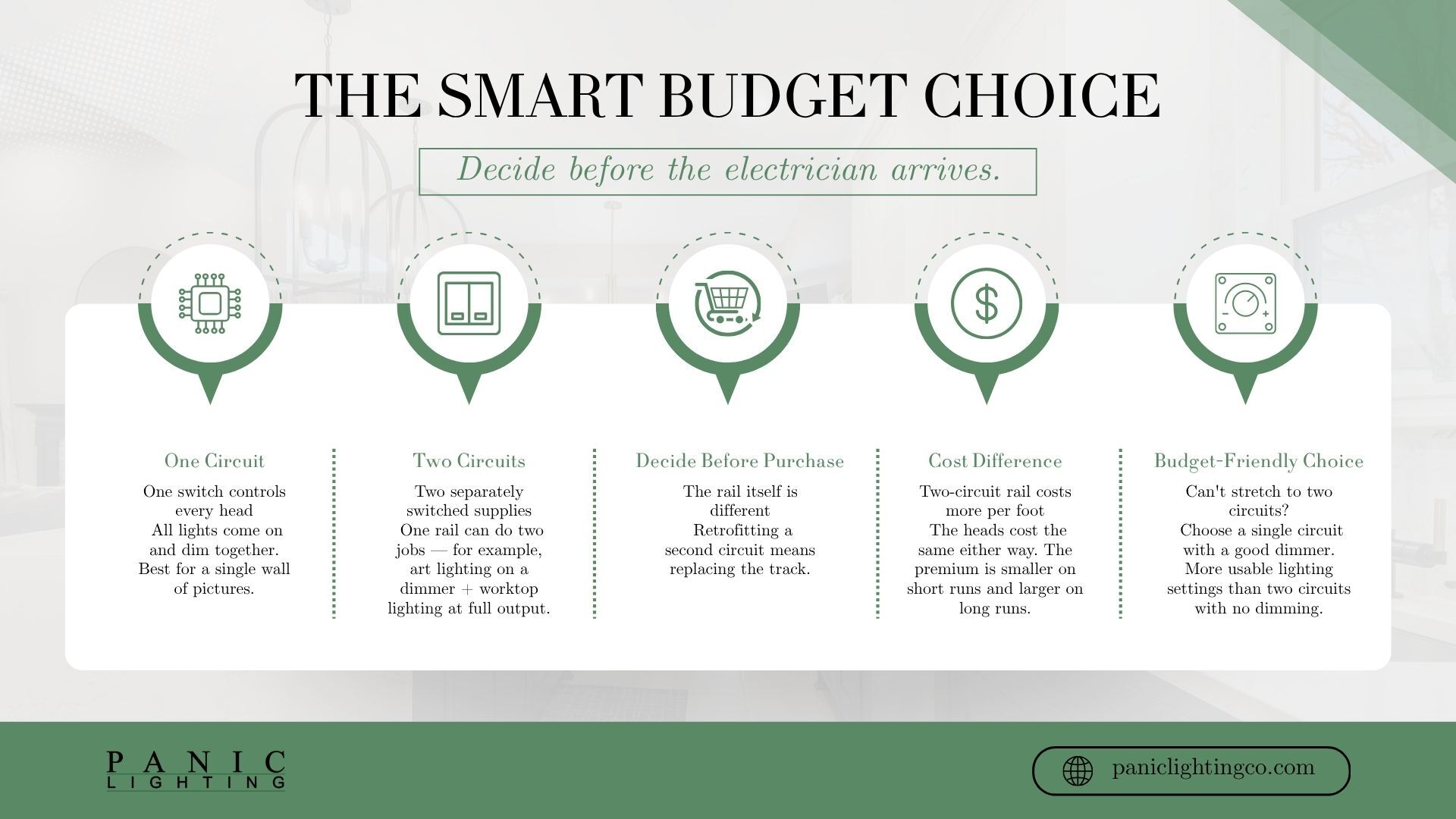
A two-circuit track carries two separately switched supplies in the same rail, and each head is set to one or the other when it goes on. That lets one run do two jobs: half the heads washing the art on a dimmer, half of them lighting the worktop below at full output, from one rail and one feed. In a long open-plan room it is the difference between a lighting scheme and a row of lights.
The decision has to be made at purchase because the rail itself is different. Retrofitting a second circuit means replacing the track.
Two-circuit rail costs more per foot, and the heads cost the same either way, so the premium is smaller than people expect on a short run and larger than they expect on a long one. Where the budget will not stretch, the useful compromise is a single circuit on a good dimmer rather than two circuits on none, because dimming buys you more usable settings than switching does.
Which heads go on which circuit is set physically at each head, usually with a small switch or by which way the adapter is turned. That means the split can be changed later from a stepladder, which is a genuine advantage over hard-wiring two separate runs of fixtures.
Where Track Wins, and Where It Looks Wrong
Rails earn their keep where the targets move: a gallery wall, a room whose furniture is not settled, a workshop, a retail counter, a stairwell with art up the flight. Anywhere you would rather adjust than commit.
It looks wrong in a formal room with a plaster ceiling, in most bedrooms, and anywhere the ceiling itself is meant to be the quiet surface. A rail is a visible piece of hardware, and no finish makes it disappear.
Mono-points are the answer in those rooms.
They are also the right call for a single strong target: one sculpture, one alcove, one painting that is not going anywhere. Our mono-points sit with the other aiming fixtures for that reason, and a pair of them reads as considered, whereas a two-foot rail carrying two heads reads as a compromise.
Heads themselves are the part people underestimate. Whether they clip to a rail or sit on a canopy, directional spotlights come in wildly different body sizes, and a head that looks neat in a catalogue can be the size of a soup can in a nine-foot room.
Recessed adjustable trims are the third option and the most discreet of the three, at the cost of needing a hole in the ceiling and near-zero flexibility afterwards.
Wall-Mounted Heads and the Corridor Rule
Aimable heads go on walls as well as ceilings, and in a hallway, a stairwell, a shop, or an office that introduces a constraint most lighting advice never mentions.
The 2010 ADA Standards for Accessible Design set protrusion limits in section 307.2: objects with leading edges more than 27 inches and not more than 80 inches above the finished floor shall protrude 4 inches maximum horizontally into the circulation path. Section 307.4 sets the vertical clearance at 80 inches minimum. The advisory attached to 307.2 explains the reason plainly enough: below 27 inches a cane finds the object in time, and above that height it does not.
Why it matters for lighting is obvious once you see it. A wall-mounted head that swings out five inches from the wall at eye level in a corridor is a protruding object, and so is a pendant or suspended track head hanging below 80 inches over a walkway.
This binds in commercial and public spaces rather than in a private house. Even at home, though, it is a sensible rule for a narrow hallway or a stair landing where somebody carrying a laundry basket is going to meet it in the dark. Our directional wall lights include shallow-projection options for exactly this situation.
If a project is genuinely under the ADA Standards, the person to confirm the details with is the designer or the code official, not a lighting store. We can tell you the projection of a given fixture, and that number is usually the one that decides it.
The commercial cases where this comes up are worth naming, because they are the ones a Columbus business is most likely to be planning. A retail wall with track heads angled out over a display aisle. Sconces down a hallway in a converted office. Picture lights along a corridor in a restaurant or a clinic. Stairwell landings, where the wall is close, and people are already looking at their feet. In each of these, the fixture is doing exactly what it should visually and may still be a protruding object.
The fixes are ordinary. Choose a shallower body, which is why projection depth appears on spec sheets at all. Mount higher than 80 inches so the limit does not apply, though check what that does to the aim before committing. Recess the fixture into the wall. Or move the light to the ceiling and aim it down the wall instead, which is often the better-looking answer anyway and sidesteps the question entirely.
Suspended track over a walkway has the same issue in reverse. Drop the rail to bring the heads to a comfortable working height, and the heads themselves can end up below the 80-inch clearance, which is fine over a counter that nobody walks through and not fine across an aisle.
None of this makes track or wall heads a bad choice in a commercial space. It makes projection depth a specification to check rather than an afterthought, and it is a question we can answer from the catalogue before anything is ordered.
Low Voltage, Line Voltage and the Transformer
Both systems come in two electrical flavours, and the difference shows up in the fixture, not the wall.
Line voltage runs the heads at mains voltage directly. Nothing extra is needed; the heads are physically larger because the driver or transformer lives inside each one, and the wiring is ordinary. It is the simpler choice and the one most houses end up with.
Low voltage steps the supply down, either at a transformer feeding the whole rail or inside each head. The heads get smaller and less obtrusive, which matters a great deal on a nine-foot ceiling where the fixture is at eye level for anyone on the stairs, and the optics available at small apertures are often better. Juno’s listing notes that its one-circuit system runs either way, which is typical of the larger track families.
The trade-off is the transformer. It sits somewhere; it can hum, and it is another component to match and eventually replace. Where one transformer feeds the whole rail, every head has to suit that supply.
For most rooms, the honest answer is line voltage unless the fixture size is bothering you. When it is bothering you, it really is worth the extra piece of hardware.
When the Room Already Has One Ceiling Box
This is the most common real-world starting point, and it deserves its own answer.
Somebody has a single ceiling outlet in the middle of a room, usually where a builder put one flush mount in 1978, and they want five points of light aimed at different things. Adding four junction boxes means opening the ceiling in four places, and in a plaster ceiling with no attic above that is a genuine renovation.
A rail solves it without any of that. The existing box becomes the feed, a canopy connector takes the rail off it, and the rail carries through many heads the run needs. One box, five lights, no new wiring, and the electrician is there for an hour rather than a day.
The catch is that the rail has to start at the box. If the outlet is dead center and the things you want lit are along one wall, the run either crosses the room to get there or you accept a rail that is longer than it needs to be. Flexible connectors and L-shaped runs help, but the geometry is what it is.
A mono-point on the existing box plus new circuits for the rest is the alternative, and it is the better-looking answer if the budget and the ceiling allow it. In an older Columbus house with lath and plaster above, they frequently do not.
Ceiling Height, Suspension, and Awkward Ceilings
High ceilings change what these systems can do, mostly for the better.
The higher the head, the further the beam travels before it lands, and the more the cone has widened by the time it gets there. That argues for narrower beams, which is covered in more depth in our guide to what directional lighting is for. It also argues for suspension rather than surface mounting: dropping track on cables brings the heads down to a working height and out of the dust.
Sloped and beamed ceilings are where mono-points quietly win. A rail wants a flat plane to sit against, and every slope, coffer, and beam is a place a rail cannot cross cleanly. Individual heads placed where they need to be avoid the whole problem.
Old houses supply the other reason. Plaster ceilings, unknown joist positions, and no attic access above make each new junction box its own small project, and that pushes the arithmetic back toward one feed and a rail, even in a room where a rail is not the prettiest answer. Both constraints are common in Columbus housing, and which one wins is usually decided by what is above the ceiling rather than by taste.
Bring a Head, a Photo, and a Ceiling Height for a Track Question
If you have an existing track, bring a head off it. That single object answers the compatibility question in about four seconds, and no photograph is as reliable.
If it is a new install, bring the ceiling height, a rough plan of what you want lit and where it sits on the wall, and a note of whether the ceiling is flat, sloped, or beamed. For a commercial job, bring the corridor width too, because the projection limit is often the constraint that picks the fixture.
We keep track of sections and mono-points on the floor with heads fitted, so you can see how far a head actually swings and how much a suspended run drops before you commit to one. Come and work it through with us at Panic Lighting Co. on Silver Drive, and bring the old head.