
Most of the Primo copper lanterns we list are sold twice: once with a gas burner and once wired for bulbs, in the same body and the same size. So a Columbus homeowner’s decision comes down to fuel, and it depends on three things you can check before spending anything. What the flame costs at Ohio’s published gas price, whether gas already reaches the spot, and what digging the post hole involves under Ohio law.
TL;DR
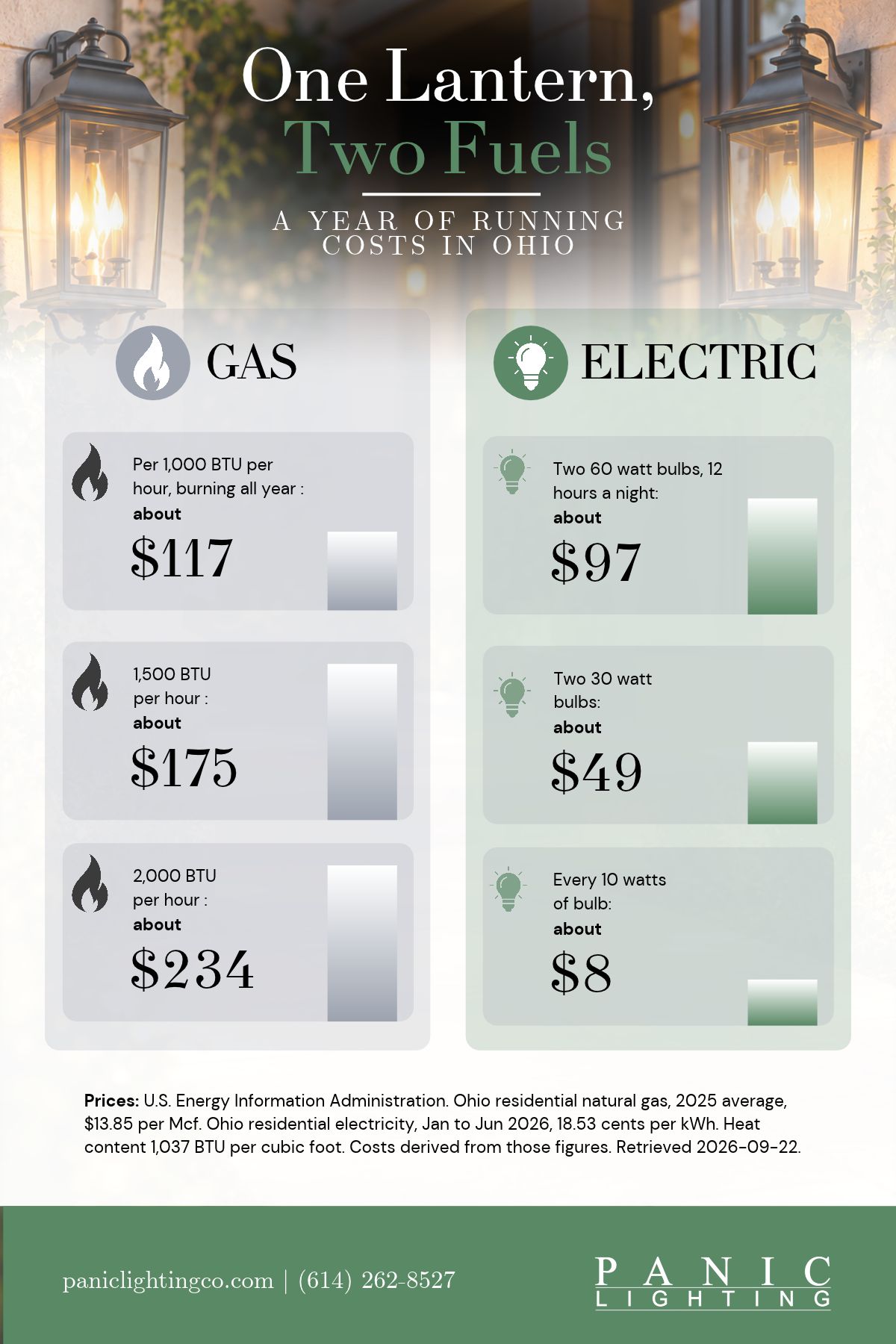
A copper gas lantern with an open flame burns around the clock, so its running cost follows the burner rating on its spec sheet. At the 2025 Ohio residential natural gas average of $13.85 per thousand cubic feet, published by the U.S. Energy Information Administration, every 1,000 BTU per hour of burner rating costs about $117 a year. An electric version of the same lantern with two 60-watt candelabra bulbs, lit 12 hours a night at Ohio’s 2026 average residential electricity price, costs about $97 a year, and far less with lower-wattage bulbs.
Gas wins on the flicker and on staying lit through a power cut. Electric wins on cost, on switching off, and on installation, because it needs no gas line. Either way, Ohio law requires notifying OHIO811 at least two working days before digging for a post.
Same Lantern, Two Fuels
Take the Orleans 18-inch lantern from Primo. It is listed as a gas model and as an electric model, and the listings read almost line for line the same.
| Listed on the product page | Orleans OL-18G (gas) | Orleans OL-18E (electric) |
|---|---|---|
| Height and width | 18 in, 10.5 in | 18 in, 10.5 in |
| Body | Solid copper | Solid copper |
| Glass | Top and bottom tempered glass | Top and bottom tempered glass |
| Mounting | Black powder-coated wall mount included | Black powder-coated wall mount included |
| Location rating | Wet rated | Wet rated |
| Safety listing | ETL | ETL |
| Light source | Gas burner | Two 60-watt candelabra bulbs, 120 volt, bulbs not included |
You can compare the gas Orleans lantern with the electric Orleans lantern side by side. The Vicksburg family is paired the same way, gas and three-light electric models side by side in every mount, and you can see the whole range in our listing of Primo gas lanterns.
That matters for one reason. Because the body is shared, the look is settled the moment you pick the model, and everything below is about the fuel.
What Does a Gas Lantern Cost to Run in Ohio?
A gas lantern costs its burner rating, multiplied by the hours it burns, multiplied by the local gas price. In Ohio, at the 2025 residential average of $13.85 per thousand cubic feet in the U.S. Energy Information Administration’s state price series, each 1,000 BTU per hour of burner rating burning all year costs about $117, or roughly $9.75 a month. A burner rated at 1,500 BTU per hour costs about $175 a year on the same basis.
Here is where those figures come from, so you can redo them for any lantern.
- Read the burner rating. It is given in BTU per hour on the manufacturer’s spec sheet for the exact model. Request it before you buy.
- Multiply by 8,760, the hours in a year. An open-flame lantern on a manual valve keeps burning until someone turns it off, and most owners leave it lit.
- Convert BTU to gas volume. The same agency’s published conversion puts the 2025 US average heat content of delivered natural gas at about 1,037 BTU per cubic foot.
- Multiply by the price. The same EIA state series gives a residential average of $13.85 per thousand cubic feet for 2025, released 31 August 2026.
| Burner rating (BTU per hour) | Gas burned in a year | Cost a year at $13.85 per Mcf | Cost a month |
|---|---|---|---|
| 1,000 | about 8,450 cubic feet | about $117 | about $9.75 |
| 1,500 | about 12,670 cubic feet | about $175 | about $14.60 |
| 2,000 | about 16,900 cubic feet | about $234 | about $19.50 |
Those three ratings are there to show how the sum scales. They are not the rating of any particular lantern, and the rating on your model’s spec sheet replaces them.
Why the monthly price swings so much
The same EIA series shows the Ohio residential price moving from $11.03 per thousand cubic feet in January 2026 to $22.83 in May 2026. A lantern burns the same amount of gas in May as in January, so a cost built from one month’s price would mislead you in either direction. That is why the table uses the full-year 2025 average.
It is still a statewide average rather than your tariff. The per-unit charges printed on your own gas bill give the exact figure for your house, and the arithmetic above takes them without any change.
The electric side of the same sum
Electricity is easier, because a bulb switches off. The OL-18E takes two candelabra bulbs of up to 60 watts each. For a rough dusk-to-dawn year, we have used 12 hours a night, which is 4,380 hours, and the Ohio residential average of 18.53 cents per kilowatt-hour for January to June 2026 from the EIA’s Electric Power Monthly state price table.
| Bulbs fitted | Energy in a year | Cost a year at 18.53 cents per kWh |
|---|---|---|
| Two at 60 watts (120 watts) | 525.6 kWh | about $97 |
| Two at 30 watts (60 watts) | 262.8 kWh | about $49 |
| Every 10 watts of bulb | 43.8 kWh | about $8 |
Check the wattage on the bulb box and scale from the last row. Put the lantern on a timer or photocell, and the hours fall further, which a manual gas valve cannot match. How warm those bulbs look next to a real flame is a separate question, and our guide to what LED color temperature means covers the numbers printed on the box.
The Pipe Decides Before the Price Does
The running cost is rarely what settles it. The gas supply usually is.
A house in Bexley or Upper Arlington that already has a gas lamp post, or a capped gas stub where one used to stand, is a very different job from a new build in Westerville with no gas anywhere near the front walk. Where gas is already at the spot, a gas lantern can be the simpler swap. Without it, somebody has to run a new branch from the house, and that is work for a licensed gas fitter or plumber, not a lighting store. We supply the lantern and the mounting hardware, and the fitter connects it.
An electric lantern needs a circuit instead. A wall lantern beside a door often reuses the wiring of the fixture it replaces, which keeps an electric swap simple. A post in the middle of a lawn needs a cable run in either case, so the cost gap narrows out there.
Four questions to settle before you pick a fuel:
- Is there a gas line, or a capped stub, within reach of where the lantern will go?
- Who will connect it, and will they handle any permit your city requires?
- If electric, is there a switched circuit at the wall, or does one need running?
- Would you want to switch it off at night, or on a timer?
If the answer to the first question is no, electric is usually the practical choice, and it looks the same from the street.
Do You Need to Call 811 Before Setting a Lamp Post in Ohio?
Yes. Everyone digging in Ohio, homeowners included, must notify OHIO811 before breaking ground, and that includes a post hole for a lamp post. According to the Public Utilities Commission of Ohio, the notice goes in at least two working days before digging starts and no more than 16 calendar days before, not counting the day of the call, weekends or legal holidays.
You notify by dialing 8-1-1. Within two working days, the utilities registered with the service send a locator to mark the approximate position of their lines, pipes, and cables. Then you know where it is safe to dig.
Here is the part most people miss. The OHIO811 frequently asked questions list electric lines running from a house to a lamppost or garden lights as private lines. They belong to the property owner, and the utilities marking your yard may not locate them. If you are replacing an old lamppost in Clintonville or Worthington, the buried line feeding the old one is probably yours, and a private locating company may be needed to find it.
| Step | What happens | Timing |
|---|---|---|
| 1 | Dial 8-1-1 and describe where and what you are digging | 2 to 16 days before digging, working days for the minimum |
| 2 | Registered utilities mark their buried lines | Within 2 working days |
| 3 | Arrange a private locator for lines you own, such as an old lamppost feed | Before digging |
| 4 | Dig the post hole | After the marks are in |
The OHIO811 answers make one more point worth knowing if you hire help: the duty to notify sits with the person doing the digging. Your contractor should be able to give you the confirmation number they receive.
Picking the Mount Before the Model
The fuel question gets the attention, but the mount decides where the lantern can go at all. Primo lists its lanterns in a set of mounting styles, and the names describe the hardware:
| Mount as listed | Where it goes |
|---|---|
| Post mount | On top of a lamp post |
| Pier and post mounts | On a post, or on a brick or stone pier at a driveway or gate |
| Gooseneck bracket | Held out from a wall on a curved arm |
| Tear yoke | Hung from a wall arm, with the lantern suspended |
| Top scroll, top and bottom scrolls, moustache scrolls | Wall brackets with decorative ironwork |
| Chain hanging conversion kit (electric) | Hung by chain, under a porch ceiling or indoors |
A lantern meant for a post belongs with our post mount lights, and one that will hang under a porch roof belongs with the hanging lanterns. The electric Vicksburg listing says the chain-hung version works indoors as a pendant too, which is not something a flame can do.
Measure before you choose. The post height or the distance from the door frame to the soffit will rule out some sizes before style comes into it.
Living With a Flame Through a Columbus Winter
A gas lantern is a small, permanent fire, and it behaves like one.
It keeps burning through a power cut. An open flame on a manual valve needs no electricity, so it stays lit when the street goes dark in a February ice storm. For some owners, that alone decides it.
It also never switches off by itself. An electric lantern on a photocell sits dark through a long July evening and comes on as the light goes. The flame burns just the same at noon.
Wind is the other thing people notice. An open flame can be blown out in a strong gust, and a lantern in an exposed spot needs checking after rough weather. A lantern tucked into a porch or under an eave suffers less.
Then there is the look. A flame moves and flickers, and it throws soft, uneven light onto brick, glass and the path. Bulbs give a steadier light. If you plan to light the front of the house rather than mark the door, a flame will not do that job, and our guide on where to place outdoor uplighting covers the fixtures that will.
A Quick Way to Decide
Weigh the four columns against your own house rather than against someone else’s advice.
| If this is true | Lean toward |
|---|---|
| Gas already reaches the spot, and you want a real flame | Gas |
| You want the lantern lit through power cuts | Gas |
| There is no gas line nearby | Electric |
| You want it off during the day, or on a timer | Electric |
| It will hang under a porch or go indoors | Electric, with the chain hanging kit |
| Running cost is the deciding factor | Electric, especially with low-wattage bulbs |
If two rows point different ways, the gas supply usually breaks the tie. A flame is worth the running cost where a line already runs, and rarely worth trenching a new one for.
Bring Your Lantern Measurements to Silver Drive
Pricing on these lanterns is by quote, so the useful next step is a conversation rather than a checkout. Bring the post height, the wall space beside the door, a photo of the front of the house, and whether gas already reaches the spot. Get the burner rating for the gas model you like and run it through the table above, or let us run it with you.
Come and see us at 3251 Silver Drive in Columbus, or start with the lanterns in the Panic Lighting Co. store. We will help you settle the fuel and the mount first, then the style, so the lantern you order fits the house and the budget you have set for running it.